The history of kung fu is littered with stories, probably apocryphal but with some credibility, of old masters, on their deathbeds, lamenting that they hadn’t passed on all they knew to at least one of their disciples. Not all teachers were like that of course: I studied wing chun for five years in the 1980s with a teacher who said he would consider himself a failure if he didn’t have at least one student who turned out to be better than him.
That wasn’t me; I was fairly useless, but I did gain some invaluable insights into one aspect of the Chinese psyche. Many Chinese sifus, while talented as martial artists, are obsessed with their own importance, which is why they expect to be addressed as ‘sifu’ (teacher). My teacher asked his students to address him as ‘Hong Kor’ (Brother Hong), ‘brother’ being the usual form of address between fellow students in the same school. In other ways, however, my teacher was almost the archetype of the traditional Chinese teacher: strict, quick to criticize and slow to praise (although I did work out how to not let that bother me).
I was reminded of all this on a recent visit to an upmarket Chinese restaurant with two friends. I’d only been there once before (not surprising given the prices it charges), and one of its signature dishes is sweet and sour pork, so I was keen to try that. You might think that sweet and sour pork is no big deal; everyone makes it. But you would be mistaken. This dish is a lot harder to make properly than most people realize; it is one of the dishes that is used to test the ability of a chef applying for a job in a top restaurant.
We were informed that the old head chef was no longer with the restaurant, but his former assistant was now in charge of the kitchen. He came round in person to talk to diners during our meal, and we asked him about his old mentor.
“He taught me everything I know,” he answered.
After sampling his sweet and sour pork, which was good but not quite the best, I couldn’t help but wonder whether his teacher had taught him everything he knew.
Thursday, 11 March 2010

Friday, 5 March 2010
reasons to be cheerful
Depressed? Feeling run down? Life is crap, right? Fate threw you a raw deal? I feel like that sometimes, but then I remember:
I don’t live in a war zone. Those who do rarely have any other choice.
I’ve never had the experience of going without food for days and still not know when I will eat again.
I don’t live in a country where the chance of being blown up by a suicide bomber is a significant consideration as I go about everyday life.
I don’t live in an earthquake zone. Unfortunately, for most of those who do, they again have no choice.
I don’t live on the slopes of an unstable hillside or in the shadow of an active volcano.
I don’t live in fear of the midnight knock on the door. I’ve always lived in societies and communities with plenty of rules, but rules are rules, and rules are meant to be followed. And if they’re not, there are yet more rules to deal with the situation where the rules are broken. In a police state (and there are still quite a few out there), there are no rules.
I’m not a member of an ethnic minority living in a neighbourhood where a brick through the window is a regular occurrence, although I do happen to be the sole representative of the only ethnic minority around these parts. However, nobody notices except my wife, although she claims that it’s a useful characteristic for me to have because she can see me coming through a crowd.
I don’t live in a region of the world where the probability that I might contract malaria, schistosomiasis or other horrible parasitic disease, or one of those nasty haemorrhagic fevers, is about the same as the probability that I might catch cold where I do live.
I don’t live in a region where the onset of a hurricane or typhoon places me at serious risk of physical injury, even of being killed. I do live somewhere that is affected by typhoons, although direct hits on Hong Kong are uncommon. But if one does hit, the worst that could happen is a few broken windows. Our house is made of reinforced concrete, so our only worry is the quality of the concrete. You might think that I’m worrying about nothing in that case, but then you haven’t seen a modern village house being built. On the other hand, the house remains standing after almost two years, so my hunch is that it would take a direct hit from a Chinese army helicopter to inflict terminal damage. Mind you, the risk of this happening isn’t entirely negligible—there’s a People’s Liberation Army base across the road.
I don’t live on the floodplain of a major river in a house that an out-of-control cyclist could knock down. I do live on a floodplain though, but it’s very small, and in any case, all the rivers around here have been canalized. I’ve often speculated as to what frequency of flooding event would overwhelm this level of defence, and I’m sure it’s at least 100 years. You’ve seen the pictures (Hong Kong Country): I don’t think I would want to be around when it does happen. On the other hand, I do know which way to run if I’m lucky enough to see the flood wave coming.
When I remember all these things, whatever petty inconvenience or annoyance I might feel aggrieved about seems utterly trivial by comparison. There is always going to be someone much worse off than me. Real shit happens to other people. I have no grounds for complaint.
I don’t live in a war zone. Those who do rarely have any other choice.
I’ve never had the experience of going without food for days and still not know when I will eat again.
I don’t live in a country where the chance of being blown up by a suicide bomber is a significant consideration as I go about everyday life.
I don’t live in an earthquake zone. Unfortunately, for most of those who do, they again have no choice.
I don’t live on the slopes of an unstable hillside or in the shadow of an active volcano.
I don’t live in fear of the midnight knock on the door. I’ve always lived in societies and communities with plenty of rules, but rules are rules, and rules are meant to be followed. And if they’re not, there are yet more rules to deal with the situation where the rules are broken. In a police state (and there are still quite a few out there), there are no rules.
I’m not a member of an ethnic minority living in a neighbourhood where a brick through the window is a regular occurrence, although I do happen to be the sole representative of the only ethnic minority around these parts. However, nobody notices except my wife, although she claims that it’s a useful characteristic for me to have because she can see me coming through a crowd.
I don’t live in a region of the world where the probability that I might contract malaria, schistosomiasis or other horrible parasitic disease, or one of those nasty haemorrhagic fevers, is about the same as the probability that I might catch cold where I do live.
I don’t live in a region where the onset of a hurricane or typhoon places me at serious risk of physical injury, even of being killed. I do live somewhere that is affected by typhoons, although direct hits on Hong Kong are uncommon. But if one does hit, the worst that could happen is a few broken windows. Our house is made of reinforced concrete, so our only worry is the quality of the concrete. You might think that I’m worrying about nothing in that case, but then you haven’t seen a modern village house being built. On the other hand, the house remains standing after almost two years, so my hunch is that it would take a direct hit from a Chinese army helicopter to inflict terminal damage. Mind you, the risk of this happening isn’t entirely negligible—there’s a People’s Liberation Army base across the road.
I don’t live on the floodplain of a major river in a house that an out-of-control cyclist could knock down. I do live on a floodplain though, but it’s very small, and in any case, all the rivers around here have been canalized. I’ve often speculated as to what frequency of flooding event would overwhelm this level of defence, and I’m sure it’s at least 100 years. You’ve seen the pictures (Hong Kong Country): I don’t think I would want to be around when it does happen. On the other hand, I do know which way to run if I’m lucky enough to see the flood wave coming.
When I remember all these things, whatever petty inconvenience or annoyance I might feel aggrieved about seems utterly trivial by comparison. There is always going to be someone much worse off than me. Real shit happens to other people. I have no grounds for complaint.
Wednesday, 3 March 2010
chopsticks
An old Chinese story tells of a wise and virtuous man who was granted a wish before dying: that he be able to visit both heaven and hell and judge for himself the difference between the two places. When he arrived in heaven, he found it to be a massive banqueting hall with long rows of narrow tables that were laden with dishes and pots of the most mouth-watering delicacies that could possibly be imagined. Every table was lined with diners, their smiling faces and light-hearted chatter demonstrating beyond all doubt that this was indeed heaven. The old man looked more closely, and he saw that everyone in that happy throng held a pair of chopsticks. And the chopsticks were more than three feet long. He looked more closely still, and he saw that in each diner’s hand, the lower chopstick was strapped securely around the thumb and could not be removed.
“I’ve seen enough,” said the old man. “Now show me hell.”
If you were expecting fire and brimstone at this point, I’m sorry to disappoint you, because when the sage arrived in hell, he found exactly the same scenario: banqueting hall, tables groaning with food, diners with three-foot chopsticks strapped to their hands. But there was one crucial difference: the diners weren’t smiling; they were scowling, glaring and arguing. And, unlike in heaven, no one was eating. The old man knew why this was the case. Do you?
In fact, variants of this story occur throughout East and Southeast Asia, and the details vary from teller to teller (I added my own embellishments), but it seems likely that it has its origins in Ch’an (Zen) Buddhism. However, this is not about religion: it is about chopsticks.
How good is your chopstick technique? You will probably be surprised to learn that a lot of Chinese people aren’t very good, probably because it’s possible to get away with a very rudimentary technique. The giveaway is where a person holds the implements: the skill level is directly correlated with the distance of the hand holding the chopsticks from the business end: the further away, the greater the efficiency, and some tasks are impossible if the chopsticks are held halfway down. And when you see someone stab a siu mai (steamed prawn and minced pork dumpling) instead of picking it up, then you know that you’re dealing with a rank amateur, yet this is a remarkably common sight.
To be considered an expert, at least by me, you should be able to perform three tasks with panache and a pair of chopsticks. First, you must be able to scoop the rice from a bowl into your mouth in a continuous circular sweeping motion. This one is easy: all Chinese can do it, but not necessarily with the stipulated panache. And you’re not supposed to leave a trail of dropped rice grains on the table either, which is the likely outcome if your technique isn't up to the standard required.
Second, and considerably harder, you should be able to cut up a plate of cheung fan (rolled-up, steamed rice-flour pancakes that are usually about 15cm long and come in threes) into bite-sized pieces. Of course, chopsticks cannot be used to cut up a sirloin steak, but soft pancakes will yield if the chopsticks are correctly applied. However, the majority of Chinese achieve the desired end-result by using one chopstick in each hand, which I regard as very poor.
Now for the real test: pick up a straw mushroom. Like peeled quail eggs, these are oval in shape, but unlike quail eggs, which are hard enough to pick up, they are also slightly slimy on the outside. If you can do this every time without the object of your desire squirting across the table, you will not only impress your friends, you will also impress any Chinese who happen to observe your performance, not least because they probably can’t do it.
And if you can’t do it either, you can always take a leaf out of the bad worker’s manual and blame your tools, especially if you’re using Japanese chopsticks, which are entirely blameworthy. The Japanese have a long history of ‘improving’ items without considering the ergonomics of their use, and chopsticks are no exception. Like a modern digital camera with its LCD viewscreen, which is less efficient in use than a camera with a traditional viewfinder, Japanese chopsticks, the ends of which taper to a rounded point, are not as effective as traditional Chinese chopsticks, which have blunt ends. No doubt the Japanese would retort that it requires more skill to use their chopsticks, but I refuse to use implements that I think are badly designed deliberately just to make gaijins look silly.
So why not use a fork? Surely western cutlery is more efficient than either design of chopstick. As an Englishman, I lean towards this point of view, at least for food prepared in a typical western style. But what about noodles? If you were to watch my wife (who is Chinese) and I eating bowls of noodles at home, you would notice that one was using chopsticks, the other a fork. Nothing contrary to expectations there then. But who do you suppose would be using the chopsticks?
“I’ve seen enough,” said the old man. “Now show me hell.”
If you were expecting fire and brimstone at this point, I’m sorry to disappoint you, because when the sage arrived in hell, he found exactly the same scenario: banqueting hall, tables groaning with food, diners with three-foot chopsticks strapped to their hands. But there was one crucial difference: the diners weren’t smiling; they were scowling, glaring and arguing. And, unlike in heaven, no one was eating. The old man knew why this was the case. Do you?
In fact, variants of this story occur throughout East and Southeast Asia, and the details vary from teller to teller (I added my own embellishments), but it seems likely that it has its origins in Ch’an (Zen) Buddhism. However, this is not about religion: it is about chopsticks.
How good is your chopstick technique? You will probably be surprised to learn that a lot of Chinese people aren’t very good, probably because it’s possible to get away with a very rudimentary technique. The giveaway is where a person holds the implements: the skill level is directly correlated with the distance of the hand holding the chopsticks from the business end: the further away, the greater the efficiency, and some tasks are impossible if the chopsticks are held halfway down. And when you see someone stab a siu mai (steamed prawn and minced pork dumpling) instead of picking it up, then you know that you’re dealing with a rank amateur, yet this is a remarkably common sight.
To be considered an expert, at least by me, you should be able to perform three tasks with panache and a pair of chopsticks. First, you must be able to scoop the rice from a bowl into your mouth in a continuous circular sweeping motion. This one is easy: all Chinese can do it, but not necessarily with the stipulated panache. And you’re not supposed to leave a trail of dropped rice grains on the table either, which is the likely outcome if your technique isn't up to the standard required.
Second, and considerably harder, you should be able to cut up a plate of cheung fan (rolled-up, steamed rice-flour pancakes that are usually about 15cm long and come in threes) into bite-sized pieces. Of course, chopsticks cannot be used to cut up a sirloin steak, but soft pancakes will yield if the chopsticks are correctly applied. However, the majority of Chinese achieve the desired end-result by using one chopstick in each hand, which I regard as very poor.
Now for the real test: pick up a straw mushroom. Like peeled quail eggs, these are oval in shape, but unlike quail eggs, which are hard enough to pick up, they are also slightly slimy on the outside. If you can do this every time without the object of your desire squirting across the table, you will not only impress your friends, you will also impress any Chinese who happen to observe your performance, not least because they probably can’t do it.
And if you can’t do it either, you can always take a leaf out of the bad worker’s manual and blame your tools, especially if you’re using Japanese chopsticks, which are entirely blameworthy. The Japanese have a long history of ‘improving’ items without considering the ergonomics of their use, and chopsticks are no exception. Like a modern digital camera with its LCD viewscreen, which is less efficient in use than a camera with a traditional viewfinder, Japanese chopsticks, the ends of which taper to a rounded point, are not as effective as traditional Chinese chopsticks, which have blunt ends. No doubt the Japanese would retort that it requires more skill to use their chopsticks, but I refuse to use implements that I think are badly designed deliberately just to make gaijins look silly.
So why not use a fork? Surely western cutlery is more efficient than either design of chopstick. As an Englishman, I lean towards this point of view, at least for food prepared in a typical western style. But what about noodles? If you were to watch my wife (who is Chinese) and I eating bowls of noodles at home, you would notice that one was using chopsticks, the other a fork. Nothing contrary to expectations there then. But who do you suppose would be using the chopsticks?
Monday, 1 March 2010
cycling in hong kong
To use a biological analogy, there are four species of cyclist in Hong Kong. By far the most numerous in the northern New Territories are what I call local cyclists, people for whom a bike is the principal mode of transport, at least over short distances. They are very common around Fanling, partly because there is an extensive network of dedicated cycle tracks here, although not all sections are contiguous. The average skill level of local cyclists is not high—they frequently have to push their bikes up the short and not particularly steep slopes that lead from subterranean interchanges to street level, for example—but apart from the odd situation that will be described later, they represent little threat, except to themselves. Many ride ramshackle machines that are badly maintained: these can be heard approaching from some distance away, even when you can’t see them.
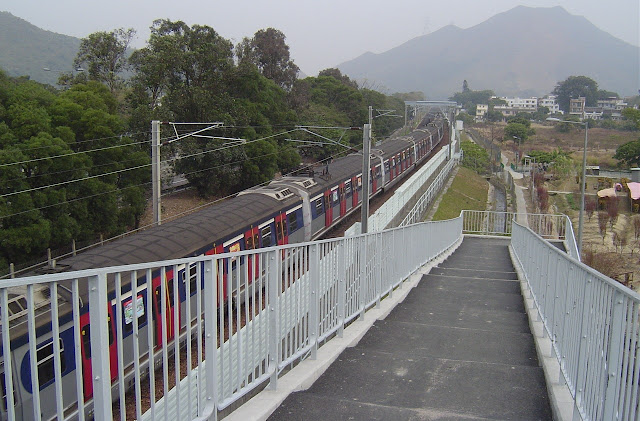
A second type is also common around Fanling: the recreational cyclist; most of those we encounter on the main cycle network ride expensive bikes with small wheels, which are the latest fashion here, although those that ride past our house at weekends are usually on conventional mountain bikes. However, the majority of recreational cyclists who make it this far north do not live in the area, and it takes a lot of skill to ride along the narrow country paths that connect Fanling to Taipo, the next sizeable town to the south. At one point, the only route crosses the railway at a footbridge, the entry to which involves a very tight hairpin bend. If you’re coming in the opposite direction, there is a three-foot drop from the edge of the path, so you can’t afford to botch the turn; local cyclists get off and push here too. The bridge itself is no pushover (unless you’re a regular cyclist): seen from a distance, there appears to be a flight of steps leading up to the bridge, but closer inspection reveals a bewildering alternation of short but steep and longer, more gentle gradients. It is terrain like this that prevents incursions of the other species of cyclist north of Taipo, albeit for opposing reasons.
Sports cyclists usually come out in herds containing as many as thirty individuals, and because speed is their principal raison d’être and because they ride narrow-wheeled racing bikes, they rarely venture away from the main cycleways south of Taipo. They seldom pose problems, although on narrower cycle tracks it can be intimidating to see a demented peloton approaching from the opposite direction, because they do tend to encroach on your side of the road. There is an arrogance about the way they ride that suggests they think they’re the ‘best’ cyclists around. They aren’t.
But they are a lot easier to live with than the fourth species: the weekend cyclist. As the name implies, these morons are only ever seen on weekends and public holidays; their skill levels range from not very good to downright incompetent. They don’t actually own the machines they ride, but bikes can be hired for the day from many places without prior proof of ability. They are the reason my wife and I never go cycling on a Sunday, and also why we don’t dally in Sham Chung on a Saturday morning after visiting our friend Tom.
Most cycle tracks here are wide enough for two cyclists to ride abreast in each direction, but south of Taipo, as far as the Hong Kong Science Park (about 7km), the track is wide enough for two double-decker buses to pass without either having to slow down. And it is marked out like a conventional road, with a central dividing line and occasional directional arrows to remind cyclists which side of the road they should be on. Both are ignored by weekend cyclists. When this section is busy, my wife likens it to Space Invaders, with the crucial difference that you have to miss the targets, not hit them.
One example of the dangers posed by weekend cyclists occurred on Christmas Eve, 2008. China Light and Power was digging up the road, so the untouched half was divided by a line of plastic cones. I was heading south, and it was clear ahead, so I was probably travelling at about 30km/hr when a small group of weekenders appeared coming in the opposite direction. I didn’t take a lot of notice, assuming that the cones provided sufficient guidance as to which side of the track they were supposed to be on. Unfortunately, the last rider in the group suddenly decided that the cones would provide an interesting slalom course. He pulled directly into my path when I was less than three metres away. Only my own fast reactions and the fact that the kerb on the left was a mere 6–7cm high, and bevelled, enabled me to bump up on to the footpath and avoid what would have been an inevitable collision for most cyclists. However, had the kerb been at a conventional height, this escape route would have been denied to me. I can still remember the six-word tirade that I launched at this idiot as I continued on my way: it included the words ‘you’ and ‘stupid’, but the other four words would be deemed unsuitable for sensitive ears.
A similar situation often crops up while we cycle through Taipo itself. Side tracks join the through route at regular intervals, and all have markings at the junctions that exactly parallel those on regular roads. In other words: ‘give way’. Not only do some local cyclists ignore this exhortation; they come barrelling out of the side road without even looking. My theory is that these people don’t drive cars, so they’ve never learned what ‘give way’ markings on a road actually mean. At least they’re predictable, which is more than can be said for the typical weekend cyclist.
Finally, the question arises: is the quantity ‘four’ the total of all possible species? No it isn’t, because I have excluded a fifth type from my general classification on the grounds that these cyclists are only ever seen on roads. And it can be argued that they’re merely a subspecies of local cyclist. However, let me introduce you to the lunatic cyclist, and an extreme example of his (they’re always men) typical behaviour.
I’d just dropped my wife off at Fanling station. My route home takes me along Sha Tau Kok Road, one of the main freight routes into and out of China. It is quite beautiful, for a road, with a long avenue of mature paper-bark trees in the middle section. It is also a two-lane dual carriageway, so traffic flow is quite brisk, despite the 50km/hr speed limit (there are no speed cameras, but there are two roundabouts and four sets of traffic lights). Anyway, I was coming off the second roundabout; the road curved to the left, and a high barrier protecting the cycling and pedestrian underpass below obscured my view forward.
That shouldn’t be a problem, because all the traffic is moving forwards anyway. Wrong! What should appear but the aforementioned lunatic, peddling furiously towards me. I barely had time to react. There are two points to make about this lamentable tale: first, the road beyond fans out into four lanes, and I was aiming ahead for lanes two or three (straight on). Had I intended to turn left at the lights, I’d have been aiming for lanes one or two and therefore a lot closer to the protective wall. I don’t think I could have missed at that range. Second, let me remind you what this fool couldn’t see (in addition to me and my car) because of the protective barrier: an interchange of dedicated cycle tracks! I often wonder what kind of deranged halfwit rides the wrong way down a dual carriageway when he doesn’t need to be on the road in the first place. Unfortunately, I have no answer to this perplexing question: the problem with stupid people is that they don’t know they’re stupid; people who only think they’re stupid are invariably pretty smart.
A second type is also common around Fanling: the recreational cyclist; most of those we encounter on the main cycle network ride expensive bikes with small wheels, which are the latest fashion here, although those that ride past our house at weekends are usually on conventional mountain bikes. However, the majority of recreational cyclists who make it this far north do not live in the area, and it takes a lot of skill to ride along the narrow country paths that connect Fanling to Taipo, the next sizeable town to the south. At one point, the only route crosses the railway at a footbridge, the entry to which involves a very tight hairpin bend. If you’re coming in the opposite direction, there is a three-foot drop from the edge of the path, so you can’t afford to botch the turn; local cyclists get off and push here too. The bridge itself is no pushover (unless you’re a regular cyclist): seen from a distance, there appears to be a flight of steps leading up to the bridge, but closer inspection reveals a bewildering alternation of short but steep and longer, more gentle gradients. It is terrain like this that prevents incursions of the other species of cyclist north of Taipo, albeit for opposing reasons.

Looking north from the footbridge with the 'steps': the path to Fanling can be seen beyond the railings.
Sports cyclists usually come out in herds containing as many as thirty individuals, and because speed is their principal raison d’être and because they ride narrow-wheeled racing bikes, they rarely venture away from the main cycleways south of Taipo. They seldom pose problems, although on narrower cycle tracks it can be intimidating to see a demented peloton approaching from the opposite direction, because they do tend to encroach on your side of the road. There is an arrogance about the way they ride that suggests they think they’re the ‘best’ cyclists around. They aren’t.
But they are a lot easier to live with than the fourth species: the weekend cyclist. As the name implies, these morons are only ever seen on weekends and public holidays; their skill levels range from not very good to downright incompetent. They don’t actually own the machines they ride, but bikes can be hired for the day from many places without prior proof of ability. They are the reason my wife and I never go cycling on a Sunday, and also why we don’t dally in Sham Chung on a Saturday morning after visiting our friend Tom.
Most cycle tracks here are wide enough for two cyclists to ride abreast in each direction, but south of Taipo, as far as the Hong Kong Science Park (about 7km), the track is wide enough for two double-decker buses to pass without either having to slow down. And it is marked out like a conventional road, with a central dividing line and occasional directional arrows to remind cyclists which side of the road they should be on. Both are ignored by weekend cyclists. When this section is busy, my wife likens it to Space Invaders, with the crucial difference that you have to miss the targets, not hit them.
One example of the dangers posed by weekend cyclists occurred on Christmas Eve, 2008. China Light and Power was digging up the road, so the untouched half was divided by a line of plastic cones. I was heading south, and it was clear ahead, so I was probably travelling at about 30km/hr when a small group of weekenders appeared coming in the opposite direction. I didn’t take a lot of notice, assuming that the cones provided sufficient guidance as to which side of the track they were supposed to be on. Unfortunately, the last rider in the group suddenly decided that the cones would provide an interesting slalom course. He pulled directly into my path when I was less than three metres away. Only my own fast reactions and the fact that the kerb on the left was a mere 6–7cm high, and bevelled, enabled me to bump up on to the footpath and avoid what would have been an inevitable collision for most cyclists. However, had the kerb been at a conventional height, this escape route would have been denied to me. I can still remember the six-word tirade that I launched at this idiot as I continued on my way: it included the words ‘you’ and ‘stupid’, but the other four words would be deemed unsuitable for sensitive ears.
A similar situation often crops up while we cycle through Taipo itself. Side tracks join the through route at regular intervals, and all have markings at the junctions that exactly parallel those on regular roads. In other words: ‘give way’. Not only do some local cyclists ignore this exhortation; they come barrelling out of the side road without even looking. My theory is that these people don’t drive cars, so they’ve never learned what ‘give way’ markings on a road actually mean. At least they’re predictable, which is more than can be said for the typical weekend cyclist.
Finally, the question arises: is the quantity ‘four’ the total of all possible species? No it isn’t, because I have excluded a fifth type from my general classification on the grounds that these cyclists are only ever seen on roads. And it can be argued that they’re merely a subspecies of local cyclist. However, let me introduce you to the lunatic cyclist, and an extreme example of his (they’re always men) typical behaviour.
I’d just dropped my wife off at Fanling station. My route home takes me along Sha Tau Kok Road, one of the main freight routes into and out of China. It is quite beautiful, for a road, with a long avenue of mature paper-bark trees in the middle section. It is also a two-lane dual carriageway, so traffic flow is quite brisk, despite the 50km/hr speed limit (there are no speed cameras, but there are two roundabouts and four sets of traffic lights). Anyway, I was coming off the second roundabout; the road curved to the left, and a high barrier protecting the cycling and pedestrian underpass below obscured my view forward.
That shouldn’t be a problem, because all the traffic is moving forwards anyway. Wrong! What should appear but the aforementioned lunatic, peddling furiously towards me. I barely had time to react. There are two points to make about this lamentable tale: first, the road beyond fans out into four lanes, and I was aiming ahead for lanes two or three (straight on). Had I intended to turn left at the lights, I’d have been aiming for lanes one or two and therefore a lot closer to the protective wall. I don’t think I could have missed at that range. Second, let me remind you what this fool couldn’t see (in addition to me and my car) because of the protective barrier: an interchange of dedicated cycle tracks! I often wonder what kind of deranged halfwit rides the wrong way down a dual carriageway when he doesn’t need to be on the road in the first place. Unfortunately, I have no answer to this perplexing question: the problem with stupid people is that they don’t know they’re stupid; people who only think they’re stupid are invariably pretty smart.

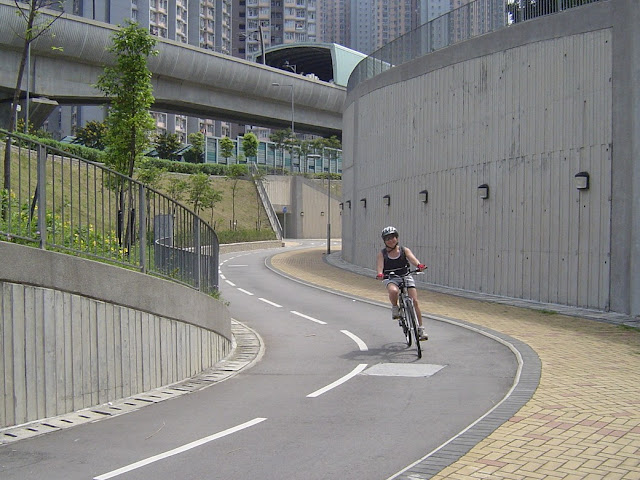
My wife negotiates a quiet cycle track on the eastern outskirts of the new town of Ma On Shan.
Subscribe to:
Posts (Atom)

