I must commence with an apology to anyone who clicked on this title expecting a vituperative diatribe against the evils of modern capitalism. I’ll provide that at a later date. Meanwhile, if you thought that I’d be denouncing the way that all the cash for infrastructure development seems to be going into my home country’s capital city, leaving provincial municipalities to scrabble for scraps from the rich man’s table, I’m afraid that I have bad news. I won’t be. Not yet.
However, I will be posing this question: are capital letters necessary? I had no thoughts on the subject until I started editing other people’s books and realized that nobody seemed to know the rules. Everybody was fine with the obvious ones, beginning a sentence, abbreviations, the initial letters of people’s and countries’ names, things like that, but I quickly discovered that there was a large grey area where authors appeared to be making up their own rules based, presumably, on what they considered important.
Thus a political scientist might have written about the British Government, or a Catholic apologist about the Pope, or a biologist about the Theory of Evolution. A schoolteacher might teach Mathematics, or Geography, or History, while other academics might refer to their place of work as ‘the University’. In none of these instances is an initial capital necessary, and their use in such circumstances isn’t easy to justify, except as an affectation.
I encountered the reductio ad absurdum of this approach to capitalization in a book on leisure management that I once proofread (I usually worked on science and philosophy titles, but also as usual I needed the money). After correcting several instances of “Leisure Manager”, my gast was finally flabbered by a passing reference to “the City’s Ice Hockey Team” (the Sheffield Steelers would have been acceptable with initial capitals). It was this absurdity that first suggested to me the idea that upper-case letters are never necessary but are merely a convention. Perhaps their use could be abolished.
However, I do foresee difficulties with any move to eliminate the use of capital letters entirely. It seems to be an elementary point, but it is clearly desirable that we continue to distinguish between ‘be’ and ‘Be’ (the symbol for beryllium), and also between ‘he’ and ‘He’ (the symbol for helium), although in both these cases the context should make it easy to determine which of these the writer intended. We would also need to know whether we were being led astray or were using LED lighting.
Mention of light-emitting diodes reminds me of the trend, over the last century, to change the way abbreviations are represented. At one time, it was standard practice to punctuate abbreviations (e.g., N.A.T.O.), but it is rare nowadays to see the North Atlantic Treaty Organization represented in this way. In fact, the trend has been, especially with pronounceable abbreviations, to dispense not only with the punctuation but also with all but the initial capital. You may think, given what I’ve written above, that I approve of this, but there are potential pitfalls. Thus, I would expect the average Westerner to recognize ‘N.A.T.O.’, ‘NATO’ or ‘Nato’, but what about ‘Asean’ (Association of South-East Asian Nations)? I suspect that many would have to reach for a suitable reference book, because if it is being encountered for the first time, its status as an abbreviation will not be obvious. And, it should be noted, both acronyms contain letters that under normal circumstances would be capitalized: ‘Atlantic’ in Nato and ‘Asian’ in Asean. However, another acronym that has been in the news lately—‘Libor’, London inter-bank offered rate—could be excused on the grounds that only the L represents a word that ought to be capitalized.
Interestingly, ‘LED’ is the only common abbreviation I can think of that is spelled out (‘el-ee-dee’) rather than pronounced as it appears (‘led’), which is probably the reason the capital letters have been retained, while terms such as ‘laser’ (light amplification by the stimulated emission of radiation) and ‘scuba’ (self-contained underwater breathing apparatus) have become so thoroughly naturalized in the language as ordinary words that many people will be unaware that they started life as acronyms, especially as any use of capitals now would seem distinctly bizarre.
There is one use of a capital letter that is difficult to avoid, and that is for the first-person pronoun I. A few years ago, I tried to eschew the use of capital letters entirely—signing my name dennis hodgson, for example—but it did seem strange to me to write ‘i’ for me. This is partly because the ninth letter of the alphabet is one of only two letters that comes as two separate pieces, and having a two-piece letter that is meant to refer to oneself seemed uncomfortably schizophrenic.
Consequently, although I continue to avoid using capital letters whenever I think they are unnecessary, I cannot provide a set of rules for their use. All I can do is to suggest that they are used sparingly, but also consistently.
Saturday, 15 March 2014

Monday, 10 March 2014
the long and winding road

In fact, there are only two metalled roads on the map apart from that followed on the ‘journey to the west’ and the 100 metres or so southeast from A. They are the ones that cross the river (the river ‘crossing’ at X doesn’t exist!), and the rest are either dirt tracks or concrete footpaths less than a metre wide—the inevitable consequence of producing a map merely by inspecting satellite photos.

My first foray down the right-hand road didn’t get me very far. In fact, this road became a rough dirt track within 100 metres, and it came to a dead end after another 100 metres or so. Or so I thought, at first. However, I failed to notice a not very obvious path to the left of the shack on the left-hand side of the track in the following photograph (marked B on the map):

The first section of this path (B–B) was easy to follow but not nearly so easy to ride; the following sequence of photos gives a flavour of this part of the route:

The reason for the yellow railing is obvious, although there are plenty of places later on the route where there is an obvious drop off the side of the path and no protective rail.

Small streams such as the one crossed by this bridge become impassable torrents during heavy rain, so a reliable bridge is a necessity.

Approaching the river.
Once the first road has been reached, the route turns right to a small village at D on the map. The first 400 metres of D–D is a dirt track, and the next photo was taken on this section. E, the start of another dirt track, coincides with the prominent tree in this picture.

The dirt road comes to an end, to be replaced by a winding path through an extensively cultivated area. There are no serious difficulties, but a lapse of concentration could have unpleasant consequences. The next seven photos were taken along this section.
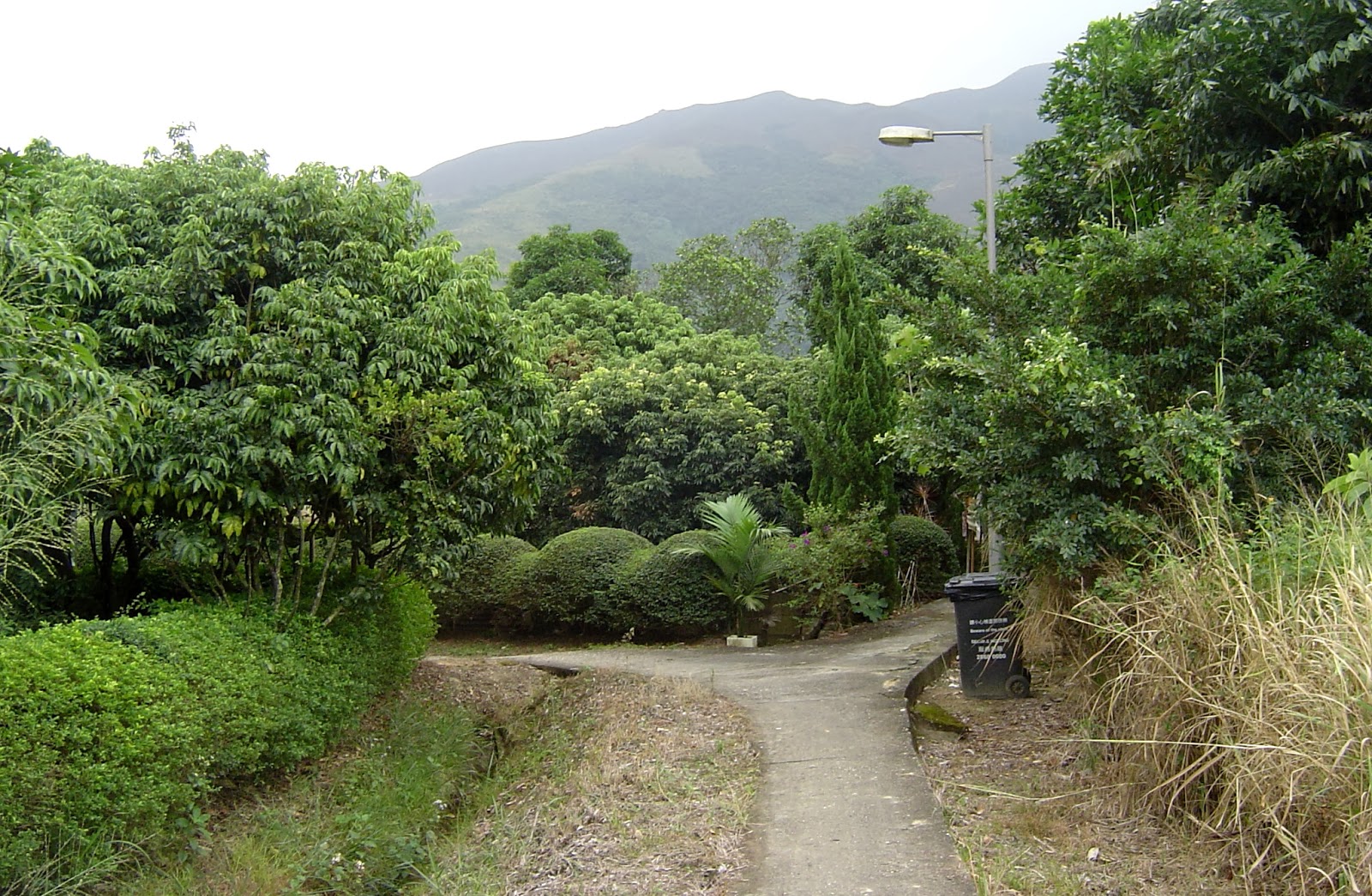
The right-hand branch is a dead end, although this doesn’t become evident until you’re almost at the junction.

As tin shacks go, this is a big one.

The bread trays on the right of the path are used as makeshift bridges by those working here to cross the irrigation ditch that runs alongside the path.

Although there is a significant drop off the inside of this bend, it’s the drop off the outside of a bend that you really need to worry about.

The slope here means that you need to be in the right gear to avoid wobbling over the edge of the path.


Nearing the end of the D–D section.
Having reached the second road at the end of the D–D section, the route then follows the road to E, where another twisting path heads towards a small temple almost literally in the middle of nowhere (there is a small village, but the only access for motor vehicles is an extremely rough and bumpy dirt track that this route follows from the hairpin bend 200 metres east of the temple).

The start of the E–E section.
The path starts by winding through a large grove of palms, and the next two photos give a good indication of the trickiness of riding along this kind of path: too slow and you risk wobbling off the path; too fast and you risk failing to make the bends. This short section is probably the most nerve-racking on the entire route.


Approaching the palm grove from the opposite direction.
The final three photos show sections of the path beyond the palm grove. The drop off the edge is big enough in some places to result in serious injury if you’re not paying proper attention.


The route that I’ve described here was the original ‘long and winding road’, but as usual I set about trying to improve it. The first thing to note is that all country paths present different challenges, depending on the direction of travel, so I set about finding a third route between the two metalled roads so that it would be straightforward to follow each path in both directions. I came up with C–C, which crosses the river at a footbridge, the location of which I’ve marked on the map, rather than at the nonexistent crossing point X. It thus became possible to follow the original route, then C–C, then a return via D–D, followed by outwards along E–E and finally a return via C–C.
This makes for quite a long and winding route that is more a test of bike-handling skills than of stamina, although our usual practice is to combine this route with the ‘frontier road’, which offers the option of taking in Liu Pok Hill, probably the longest category 1 climb in the area. In fact, we’ve taken to adding this to the ‘journey to the west’ in a kind of ‘grand tour’, which gives a route of around 100km, with Liu Pok Hill near the end. Not easy.
see also
Room for Improvement
Thursday, 27 February 2014
an unhappy garden

‘Happy Garden’ sounds like the name of a restaurant (I know of one such in Kowloon), but this post is about a real garden, although in its present condition it probably has as much in common with a restaurant as with a functioning garden.
I’d probably ridden past it on several occasions without noticing, because it isn’t easy to spot. It retires between two thick projections of bamboo, and the three-foot drop on the left off the edge of the road means that my attention has to be directed straight ahead. In case you’re wondering, the drop-off was always on my left because, when cycling in the opposite direction, I always take an alternative route.
Anyway, I do glance around whenever I can, and recently as I looked to my right, I just happened to notice an ornate entrance with nothing beyond it. My curiosity was piqued immediately. As you can see from the photograph above, this gateway is falling apart, and it appears to have been abandoned to the ravages of nature for quite some time.

The principal culprit for this disintegration appears to be a small tree, which can clearly be seen to the left of the entrance. The lintel above the gateway proclaims that this is the entrance to Happy Garden, and each of the columns supporting the lintel has eleven characters carved into it. Unfortunately, erosion of the rock from which these columns were made and the encrustation of lichen accumulated over many decades make this writing almost illegible, although I was able to learn that this is a place where one can find peace and tranquillity. There is no date.
So what kind of garden was it? Nowadays, the only plant that can be seen in the remains of the garden is bamboo (see photo below). But bamboo is not a particularly invasive plant—there are a few pernicious weed species in Hong Kong (lantana, morning glory and mile-a-minute vine spring to mind) that would have choked out any attempts by the bamboo to colonize the abandoned garden. I therefore conjecture that planted bamboo was the main feature of the garden.

However, in trying to find out more about the history of the garden, I came across one apparently reliable source that claims it was once a lychee orchard. This does seem to be implausible; at any rate, there is no longer any sign that trees were once found on this site (the tree that is currently engaged in demolishing the gateway must have appeared only after the garden was abandoned). On the other hand, the absence of any evidence that there were formal walkways in the garden does lend tenuous support to the lychee orchard hypothesis, although an orchard is not the kind of place where I would expect to find peace and tranquillity.
I am therefore compelled to leave the question of the garden’s origins and purpose until I have more convincing evidence to work with. I am also interested in finding out when the garden was established, and when it was abandoned. There is one possible clue less than 100 metres west of the Happy Garden:

This is Shek Lo, which would ordinarily translate as ‘the mansion of Mr Shek’, except that the architect and first resident was named Peter, and the Bible tells us that Peter means ‘rock’, while shek is Cantonese for ‘rock’. This doesn’t seem like a coincidence. The mansion was built before the Second World War, but how long before I’ve not been able to discover. It was finally abandoned in the 1980s, and as can be seen in the photo, it is now severely dilapidated and choked with weeds, which have so far thwarted all my attempts to take a closer look. There appears to have once been a connection between the garden and the mansion, and I will be returning to this subject if I can find a way through the undergrowth. I have a few mysteries to clear up.
Tuesday, 4 February 2014
a horse with no name
Firecrackers have been illegal in Hong Kong since the 1967 riots, when they were a ready source of gunpowder for those citizens of the territory who were intent on destabilizing the colonial administration by planting bombs (the Cultural Revolution was in full swing on the mainland at the time). It has always struck me as a pointless prohibition, partly because anyone who has passed O-level chemistry should be able to concoct an explosive mixture without recourse to ready-made materials, and partly because the law doesn’t appear to be enforced with any degree of vigour—over the course of the Chinese New Year celebrations, I hear firecrackers being set off at frequent intervals throughout my neighbourhood.
For those of you who don’t follow such matters, we have now entered the year of the horse, and if you do follow such matters, you will know that people born in the year of the horse…


There is an octagonal box at the top of the string of firecrackers, clearly visible in the third photograph. It is packed with gunpowder, so its ultimate explosion brings the cacophony to a rousing conclusion, as captured by the fourth photo.
The following sequence of photos is from the lion dance. The character in the papier mâché mask appeared for the first time last year, and I do not understand his role in the ritual, but his presence does boost the entertainment factor:


On the third day, the main attraction where I live is the ceremony of the roast pigs, which can be seen on the temporary altar in the following photo:

Naturally, the ceremony is preceded by another string of firecrackers:


In case you were wondering, much of the roast pork is eaten on the spot—it’s delicious, by the way—and the rest is distributed around the village. And that’s what I like about Chinese New Year: it always comes in with a bang!
footnote
There is an urban legend, which I’ve probably done as much as anyone to propagate, that it is always cold in Hong Kong during Chinese New Year. Not this year, however, even though the holiday was earlier than usual. Thanks to a mild maritime airstream (unheard-of at this time of year, when the northeast monsoon is supposed to be in charge), the afternoon temperature in the Fanling area exceeded 26 degrees throughout the holiday period. I’m not complaining, by the way.
For those of you who don’t follow such matters, we have now entered the year of the horse, and if you do follow such matters, you will know that people born in the year of the horse…
…have ingenious communicating techniques and always want to be in the limelight. They are clever, kind to others, and like to follow adventurous careers. They sometimes talk too much, and they are cheerful, perceptive and talented, but they are also stubborn. They like entertainment and large crowds. They are popular among friends, active at work and refuse to be reconciled to failure, although their efforts cannot last indefinitely. However, they cannot bear much constraint, and their interest may be only superficial and lacking real substance. They are usually impatient and hot-blooded about everything other than their daily work. They are independent and rarely listen to advice. They have strong endurance but also a bad temper. They are flamboyant by nature but are wasteful, since they are not good in matters of finance. Some of those born in the year of the horse like to move in glamorous circles while pursuing high-profile careers. They tend to interfere in many things but frequently fail to finish projects of their own.If you are a regular reader, you will also know that I don’t believe it possible to predict a person’s personality from the entirely arbitrary year in which they were born. However, my skepticism doesn’t spoil my enjoyment of the celebrations that bring in the new year, which for me begins with firecrackers and a lion dance on the first day:
There is an octagonal box at the top of the string of firecrackers, clearly visible in the third photograph. It is packed with gunpowder, so its ultimate explosion brings the cacophony to a rousing conclusion, as captured by the fourth photo.
The following sequence of photos is from the lion dance. The character in the papier mâché mask appeared for the first time last year, and I do not understand his role in the ritual, but his presence does boost the entertainment factor:
On the third day, the main attraction where I live is the ceremony of the roast pigs, which can be seen on the temporary altar in the following photo:
Naturally, the ceremony is preceded by another string of firecrackers:
In case you were wondering, much of the roast pork is eaten on the spot—it’s delicious, by the way—and the rest is distributed around the village. And that’s what I like about Chinese New Year: it always comes in with a bang!
footnote
There is an urban legend, which I’ve probably done as much as anyone to propagate, that it is always cold in Hong Kong during Chinese New Year. Not this year, however, even though the holiday was earlier than usual. Thanks to a mild maritime airstream (unheard-of at this time of year, when the northeast monsoon is supposed to be in charge), the afternoon temperature in the Fanling area exceeded 26 degrees throughout the holiday period. I’m not complaining, by the way.
Subscribe to:
Posts (Atom)

