Thursday, 25 December 2014

the great dolly mixture robbery

Between 2000 and 2002, I wrote a comic fantasy novel about mythical creatures called gelgins, based on an idea I’d had more than two decades earlier but not acted upon. However, after two years of trying to find either a publisher or an agent, I gave up, because the book clearly wasn’t good enough overall, although there are passages that I still think are funny. What follows is one such passage, which is the opening ‘episode’ in the tenth and final chapter of the book. Key previous events in the story should be obvious, apart from the complicity of sheep in the robbery that is the climax of the story. So, if you’re fed up with turkey and the rest of the traditional festive comestibles, if you can’t find anything worth watching on TV, or if you simply want to read something utterly daft, here you are. Some background information on gelgins can be gained by reading Chaos Theory. You may well conclude that no publisher in their right mind would want to be associated with such drivel.

*  *  *

The daring daylight dolly mixture robbery was an immediate sensation in the wider world, where it abruptly replaced a scandal about a black labrador called Judy and a gadgie’s* bag of sticky treacle toffees as the hot topic of conversation at the nation’s breakfast tables. The BBC, with one eye on the calendar, had initially decided that the whole thing had been an elaborate hoax, so the tabloids were the first to run the story, although in their news treatments ‘gallop’ would be a more accurate term. As you would have expected, there was heavy bias towards the alien visitor hypothesis, but neither the broadsheets nor the heavyweight weeklies nor the local village gossips were far behind in their promotion of this explanation.

The BBC, perhaps to atone for its earlier oversight, even condescended to discuss the circumstances surrounding this brass-necked effrontery to civilized behaviour on respectable Radio 4, where the presenters on the Today program, not being required to keep straight faces as they would, presumably, on television, were assigned the task of interviewing all the usual suspects. Senior police officers presented purportedly factual accounts, but they were unable to establish any credible motive, although the opportunity had been obvious, and there were other notable gaps where the evidence was a bit thin. Important scientists, led by that redoubtable Dr Rhadamanthus McLott of earlier newsworthy notoriety, offered what they claimed were logical explanations, but these were also founded on a paucity of proof, in solid, liquid or gaseous form. And, as we have come to expect, all the country’s leading politicians provided the usual vapid evasions, although there were earnest assurances that everything was being done to combat this sort of thing.

But to counterbalance all this objectivity and to maintain the program’s near legendary, bend-over-backwards reputation for even-handedness and fair play, an arresting array of scintillating cynics and sympathetic psychics, eclectic eccentrics and inimitable mimics, mysterious mystics and rumbustious rustics, and men who keep score at cricket because nobody else wants it were allowed their turns at the microphone, and between them they offered every conceivable theory, and some that you wouldn’t have thought were within touching distance of being conceivable this side of the next millennium. In fact, so many came forward that the statutory minimum duration of a period of fame had to be slashed from the fifteen minutes originally stipulated by that nice Mr Warhol to twenty-seven seconds.

There were grave financial repercussions. The collapse of international futures markets in dolly mixtures led to massive short selling of liquorice allsorts and even shorter selling of jelly babies. Many leading economists predicted huge flights of capital into fruit pastilles and the immediate closure of unprofitable sherbet mines with the loss of hundreds and thousands of jobs. In the ensuing confusion, several toffee-nosed financiers attempted to fudge the issue by selling their contingency reserves of gold nougats at less than market price. All right, own up! Who’s behind this? Who’s responsible for all this uninvited confectionery? And so far nobody has been able to butterscotch the rumour that a very small country with a surprisingly large army of chocolate soldiers has cornered the market in oil of peppermint. Now, that’s enough! Enough humbug, that is. Can we get on with the story?

The official police investigation was hampered from the start by several problems, although they did have some clues. There was the bucket of petrol that the escaping gelgins had left in the car park and the plastic tubing that had been used to tie up the driver, both of which were identified as having been stolen from a car in the same car park late in the evening before the robbery. The owner of that car hadn’t bothered to report that someone had nicked his bucket, but he soon came forward when he heard about the large reward being offered for information leading to the apprehension of the thieves. And everybody was hugely relieved that nobody had kicked the bucket while it still contained the petrol, or during the remainder of the madcap chase, for that matter. Now that really would have been beyond the pail.

There was also the plastic ketchup bottle that Sneedl’bodja had so thoughtlessly tossed into the hedge. There were no fingerprints, and the mysterious smudgy marks that were discovered by the fingerprint expert offered nothing on which to base a hypothesis. Apparently, though, the bottle had once contained an unknown explosive substance, and this was quickly identified by the forensic team, although no details were made public at the time, so we’ve only their word for it. In any case, not one of these items provided any firm leads, which meant that the police were in distinguished company, because no one else had any ideas about this business either, although, somehow, it didn’t seem like a meticulously planned operation. This was about the only thing that the police got right in the entire investigation.

For example, the driver gave highly misleading descriptions of the robbers. They were not inaccurate, exactly—the driver had an uncanny memory for faces—but he did exaggerate their heights. Rather a lot, actually. Mainly to avoid being thought a fool, he neglected to mention that the robbers were not of average height. And, by the merest coincidence (not another one) he just happened to be the only gadgie to have seen our bold buccaneers in all their menacing swash and buckling, all their dastardly do and derring, so the police thought they were hunting three gadgies. And his descriptions may have been full of detail, but—and here’s the really clever part—the disguises that were worn by the robbers were so obviously and transparently counterfeit that they attracted all his attention, and he was able to describe them in minute detail, but he forgot to notice anything else. There were many scores of other eye-witnesses too, all of whom were prepared to swear that the devilish driver was wearing a mask, but not one was able to furnish a single concrete detail of his real appearance. Strange. Well, yes, he probably did look strange.

There was another mystery. The police couldn’t understand why the robbers had made off with the wagon’s entire load of dolly mixtures but had left behind a leather satchel containing twenty-five thousand pounds in used banknotes, which was in the wagon’s cab. However, by way of consolation, and to demonstrate that the investigative powers of the police are all they’re made out to be after all, this satchel turned out to be the first clue to the existence of an international money-laundering operation with its headquarters in a Chinese laundry in Bethnal Green, although it did take the police team rather a long time to find that out, and they did lose several shirts in the process.

In desperation (ewe will not believe this), the police decided that they would round up scores of sheep† from the fields and fellsides in the immediate vicinity of the stolen wagon’s final journey on suspicion of going on the rampage, or perhaps of being ram raiders. The ramifications of this sinister development were not clearly understood at the time, but it led to the sheep being interrogated by a ramshackle panel of experts in strange behaviour, who threatened that non-cooperation would mean a one-way trip to the abattoir. This, of course, is strictly against the Geneva Convention, but nobody squealed, or, to avoid the porcine connotations of this word, not a single sheep bleated, even though some of the younger ones were threatened with the notorious rack of lamb. They all pretended to be mutton.

A massive reward was offered to anyone who could provide a convincing explanation that did not invoke crop circles, but eventually the investigation ground to a halt, reached a dead end, came up against a brick wall, ran out of steam, hit the buffers, petered out, and switched off the light and retired for the night. Nevertheless, there was a fall-back position, as the detective superintendent left in charge of the case pointed out at a packed press conference several weeks after the heist. Alien visitors. Alien visitors? Sherlock Holmes may have said that once the impossible has been eliminated, that which remains, however improbable, must be the truth. But neither the illustrious Baker Street consulting detective nor his partly baked modern counterpart had ever heard of gelgins, and as Holmes also said, on numerous occasions, it is impossible to build a watertight case unless you are in possession of all the relevant facts. And the perplexed detective leading this investigation had a case that was leakier than a string bag. A purportedly rigorous proof that the Earth is flat would have been more likely to convince, especially when any alien visitor could have told you, if you had only bothered to ask, that it is in fact pear-shaped. Isn’t it?

In his earlier flirtation with celebrity, Dr Rhadamanthus McLott had quickly discovered that no one was interested in his theories once it had become clear that he had no little green gender-neutral entities to spring upon his audience, but now that his carefully assembled hypothesis had become official police policy, he was overwhelmed by demands for interviews from all and sundry, amateur and professional, anyone, in fact, with a boredom threshold high enough to be able to tolerate the tedium of a typically tortuous scientific exposition. And as this particular strain of long-windedness goes, Dr McLott’s explanations were more circumlocutory than a bypass for Birmingham that goes via Bristol, Exeter, Plymouth and Penzance, not necessarily in that order.

Although a handful of investigative journalists between them interviewed every single gadgie in the entire valley, they unearthed no evidence that would support any kind of explanation for the abrupt disappearance of three tons of dolly mixtures, seemingly into thin air. The editor of UFOria, a magazine for the seriously loose of slates, was especially disappointed not to be able to confirm his own pet theory, which was that some friends of his from Alpha Centauri were responsible for the heist. Some reporters did hear a few tales of poltergeists, but no more than the national average, and Crazy Maisy did tell several that the gelgins were responsible, but they had been forewarned that she was quite a few boats short of a flotilla, so nobody believed her. There was also an odd tale about ‘whisky that drank itself’, but that had happened so long ago and was of such doubtful reliability that nobody bothered to follow it up. It seemed more like a pathetic ruse to relieve gullible city slickers of the price of a double whisky rather than an important clue.

With nothing concrete to feed the initial media frenzy, interest quickly ebbed, and the tabloids soon went back to their more usual fare, world exclusive ‘revelations’ about gadgies who think they’re famous, handy pull-out guides to the healing powers of crystals and other such tosh, and interviews with gadgies who claim to talk to flowers. The presenters of Today were hugely relieved to be able to return to their stock-in-trade, interviewing gadgies who think they’re important, and they were most severe on anyone who so much as dared to mention the Great Dolly Mixture Robbery.

* gadgie: the gelgin word for a human.
† a flock of sheep provided crucial assistance during the robbery.

Friday, 12 December 2014

the eastern descent

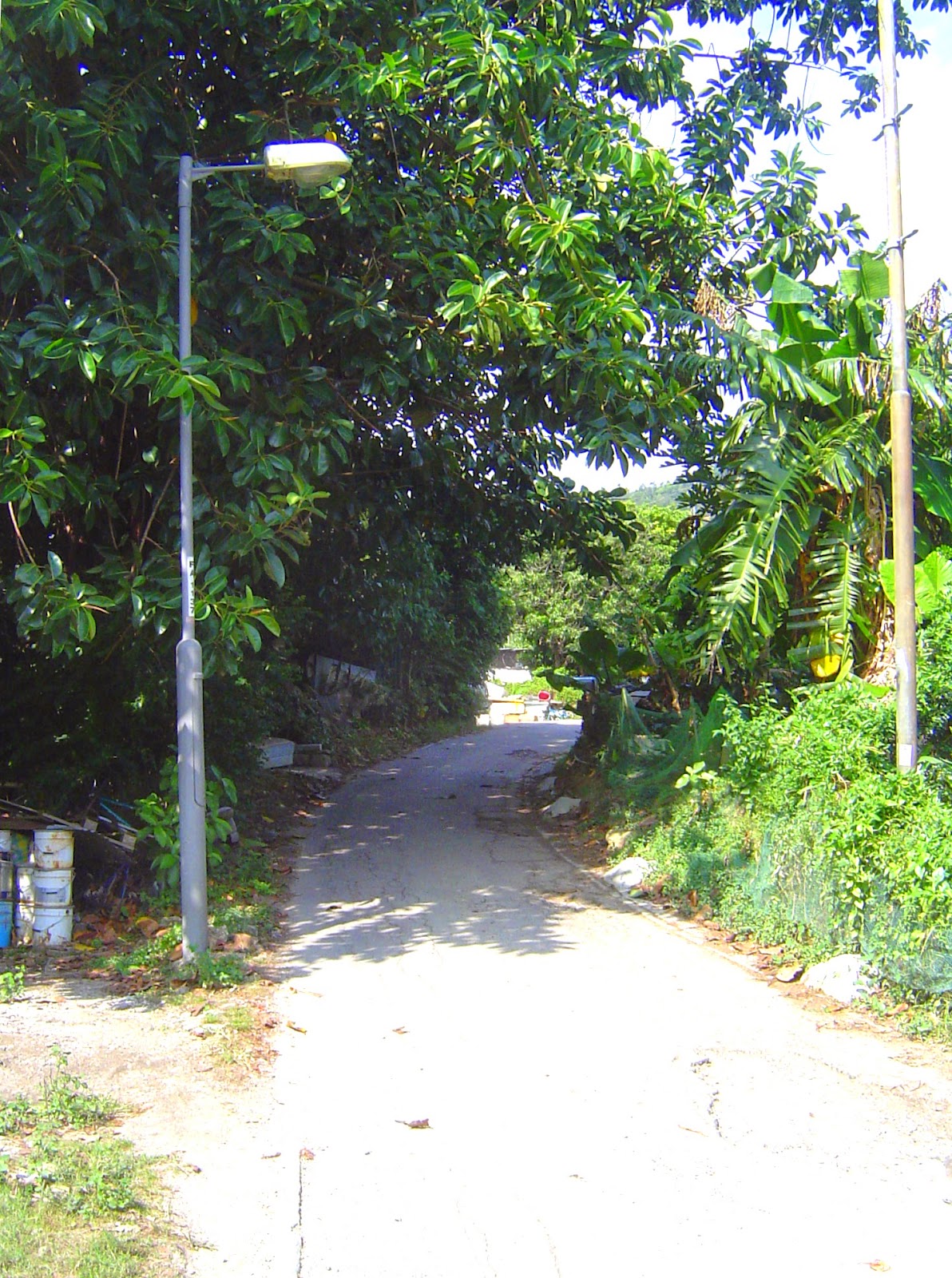
If you’ve been reading any of my other cycling posts, you’ll know that I have a particular fondness for what I usually refer to as ‘twisty paths’ (see Journey to the West: Part 4; Journey to the West: Part 5; The Long and Winding Road). This post documents such a path, one of my favourites and one that is within walking distance of my house. It starts near the walled village of Tung Kok Wai and goes down to the Sha Tau Kok Road, a major freight route into and out of China. It is the shortest route from Tung Kok Wai to the main road for pedestrians and cyclists, but it’s not for the faint-hearted, with severe drops off the side of the path at several points along the way.

Although this path is close to my home, I follow it only when returning from afternoon tea at Sun Ming Yuen Restaurant, which is located next to Fanling railway station. There is a more direct route, following cycle tracks that run alongside Sha Tau Kok Road, but this involves crossing two major junctions on the level, so I decided to see whether there were any alternatives. There were, and this path forms part of one such option.

The following sequence of photographs gives a flavour of the route. The drop off the side may be intimidating, but unlike some of the other twisty paths that I negotiate regularly, there are no technically challenging sections (tight bends, etc.) here. The photos are arranged in sequence, starting at the top.


If you do find yourself cycling on this or any other similar path, you should remember the golden rule: always defer to pedestrians; these are, after all, footpaths.

Friday, 21 November 2014

good idea, poor execution

What is the Hong Kong government’s policy on cycling? At first glance, it would seem to be extremely positive; this extract is from a government website:
Cycling is a great way to enjoy Hong Kong – you will become fit and healthy. As a bonus, you will get to see the natural beauty all around us.
Unfortunately, if you were to dig a little deeper, you would find that the policy is deeply flawed. It seems to me that the government is anxious to segregate cyclists in their own little universe, even to the extent of squandering vast sums of money in the process.

This may seem an outrageous statement to make, so I should elaborate. The government is in the process of constructing a dedicated cycle track from Sheung Shui to Yuen Long. Work started during the summer, and if there was a consultation period beforehand, I missed it, because I was in the UK. As a regular cyclist, I would have objected.

The work that is currently underway follows the west bank of the river northwards from Sheung Shui, as shown on the following map, which I obtained from the website of the Civil Engineering and Development Department (CEDD). The section in question has been circled and labelled A (the grey sections indicate where work is in progress, while the parts of the proposed route where work hasn’t yet started are coloured pink).
The project forms part of the NT Cycle Track Network which connects local cycle track networks in various new towns and is mainly for recreation purpose. The works under this project comprise the construction of new cycle tracks of approximately 11 km long from Yuen Long to Sheung Shui together with the provision of supporting facilities.
CEDD website (italics added).

I have two questions. Why is the Drainage Services Department (DSD) access road being duplicated here? And why did work start with this section in the first place, when there is already a perfectly good DSD access road, which carries only local motor traffic and has regular speed bumps to deter speeding, while there are no safe options for cycling at present along the middle section of the proposed route? This is the basis of my contention that the government wants to keep recreational cycling apart from all other vehicular traffic. In fact, I can foresee a day when cycling on the access road instead of the new cycle track results in a ticket for the rider.

The following photographs show part of the access road, with the adjoining construction work. Note the big concrete retaining wall, the size of which can be measured by the worker in the first photo. I do wonder why this is needed, unless the plan is for the cycle track to go under the Sheung Yue River, which the access road crosses via a perfectly adequate bridge (behind the camera in the second photo). And what neither photo shows is the large number of trees that have been removed to make way for the cycle track.


Because work on this section is already underway, it will be completed before the section beyond the DSD access road, which means that recreational cyclists who were not already aware of cycling possibilities in this area will come here, reach the end and then be forced to turn back, which seems like a pointless exercise to me. Unless we’re careful, we could end up with the kind of mayhem that exists on the wide cycleway between Shatin and Taipo at weekends and on public holidays, when the system is clogged up by weekend cyclists who hire their bikes for the day but have no idea how to ride them. Perhaps such anarchic conditions already prevail in this area on Sundays, but I never go out cycling on Sundays, so I cannot confirm this possibility.

And what about my earlier comment about squandering vast sums of money? According to the CEDD website, the estimated cost of this project is HK$536 million (£44 million; US$69 million), which I would have taken to be the cost of the entire section but for the appearance of ‘7259RS’ on the map. This number also appears on the webpage detailing the project and is clearly a project number applying to the whole of the route shown on the map, yet the obvious inference from the map is that the cost estimate applies only to the part of the project between the green arrows.

I should emphasize that I’m not against the government spending money to improve the territory’s cycling facilities, but I consider that spending this amount of money without an accompanying, hard-hitting campaign to improve the standard of proficiency of the cyclists who use these facilities is not money well spent. I have yet to see any public information films on cycling safety, and I can’t help wondering whether many regular cyclists have read the safety tips provided on the Cycling Information Centre’s website.

I make these comments because I frequently see examples of poor cycling practice when out on my bike. Earlier this week, I was riding along the cycle track marked with a solid grey line in the bottom left-hand corner of the map when I spotted a lone cyclist coming towards me on the adjacent road, which is a dual carriageway that carries high-speed traffic.

However, the most egregious example of poor practice that I’ve witnessed this year occurred as Paula and I began the climb over Saddle Pass from the west, where we encountered the stragglers in a group that we both estimated to contain at least forty riders. I thought that they didn’t seem very confident, but Paula told me later that some of them didn’t even know how to change gear! This on a hill where I go from ninth gear at the bottom to second gear at the top. And when I reached the top section, which has a gradient of around 30 percent, the members of the group who had reached this point were all over the place as they pushed their bikes up the hill. I wonder what they’d have done if a big truck had suddenly appeared over the brow of the hill from the opposite direction—this road does carry some motor traffic, although it isn’t busy—given that their entire focus was on what they were doing while ignoring whatever was happening around them. And I wonder whose idea it was to take so many beginners over such a demanding route in the first place.

The proposed cycle track should keep inexperienced cyclists happy and away from the hills, but I can’t see either myself or Paula using it. Our preferred route may even be safer, albeit for cyclists who know what they’re doing. Meanwhile, I repeat my earlier question: why wasn’t work on the central section of the proposed route, from Kwu Tung to Fairview Park, started first?

correction
Sod’s law in action! I took the photos on Wednesday and wrote the post on Friday, but by Saturday the situation on the ground had changed. Earth had been dumped all the way to the top of the concrete retaining wall in some places, so my surmise that the plan is for the track to go under the Sheung Yue River is clearly incorrect. My excuse is that the material at the base of the wall was being rolled, which suggested that it wasn’t too far below the eventual level of the track. And I do wonder how adequately the newly dumped material will be compacted.

Thursday, 13 November 2014

journey to the west: part 5

When I originally worked out ‘journey to the west’, it involved returning along the same route as that taken on the outward journey. However, in Part 3, I described two alternative return sections, and in Part 4, I provided details of yet another alternative, the notorious ‘snake path’. This post provides details of the only other locations where such an alternative route home is possible.

*  *  *

For many months, I believed that the tunnel under the railway described in Across the Tracks and The Hill was the only point where it was possible to cross the main line north of Sheung Shui station, which is the last stop before the border with the rest of China. However, one day I arrived at the tunnel only to find that access had been blocked by the railway company, which was engaged in repairs to the track’s overhead power lines. I had no option but to seek an alternative, believing at first that no such alternative existed.

Nevertheless, it turns out that there is a second crossing point, following a dedicated cycle track that runs alongside a major road, Po Shek Wu Road. This cycle track is reached by turning right just before Beas River flows into the Shum Chun River and following the latter upstream until it is possible to cross the river at a footbridge. The road reached by this route has a cycle track running along the far side that leads into the local network.

This network is the principal means of access to the roads around the Shum Chun River catchment for recreational cyclists from the city, who take the train to Sheung Shui. However, my destination is not Sheung Shui station, so it is necessary to abandon the cycle track network at some point. This involves yet another twisting path, one that has some extremely tricky sections.

I’m being deliberately vague about the location of this path, because quite a lot of people live here, and a large cycling group following it would be a serious nuisance to them, and to the other locals who use it, especially if some members lacked the close control that is essential on such paths. I probably wouldn’t use it myself, except that, living only a mile or so upriver, I regard myself as a local. I took the following photographs, which have been arranged in sequence, yesterday after walking from my house.

The start of the path.

A closer look at the bend seen in the previous photo, which is extremely tricky to negotiate.

Having successfully negotiated the bend seen in the previous photo, the task now is to maintain a straight line and thus avoid the sharp drop on each side of the path.

Further along, this brown dog can usually be seen asleep on the path. It used to move when I first came this way, but it appears to recognize me now and thus pays no attention.


This is one of the few places where it’s possible to overtake a slow cyclist.


It isn’t obvious from this photo, but this is the apex of a 180-degree bend, with the ubiquitous drop-off on each side of the path. From this and the next photo, it is obvious that the path has been widened here, presumably because people found the bend impossible to negotiate safely.

No sooner has the path straightened out from the previous bend than it sweeps away in the opposite direction.

Nearing the end of the path.

*  *  *

The ‘posh street’ mentioned in Part 2 backs onto the same tributary that we follow later in the journey to reach the Kam Tin River, but there is a Drainage Services Department (DSD) access road on the other side that carries almost no traffic. We’ve been following this access road on the return journey for several months now, crossing the river at a footbridge opposite the bottom entrance to Tam Mei Camp, the second of the PLA bases described in Part 2, to rejoin the original route.

However, the access road continues up the valley and thence out of sight, and according to Google Maps it should be possible to add an additional 3km loop to the route. I’ve just checked this out in the last couple of weeks, armed with a printout of the following map:


The line of red dots marks the route I planned to follow, if possible, in an anticlockwise direction, although previous experience suggested that some at least of the roads might turn out to be mere footpaths and thus difficult or even impossible to ride along. I was delighted to discover that apart from a short section following the initial turn off Chun Shin Road (the access road), which is an untypically flat-surfaced dirt road (see the first photo below), the rest of the loop is along quiet lanes with very little traffic, making this a worthwhile addition to the overall route.

If you look closely at the first photo, you might just be able to make out two large tower cranes camouflaged against the forested hillside. Hong Kong’s connection to China’s high-speed rail network will eventually pass through this mountain. The remaining photos give a flavour of the riding conditions along the loop, which turned out to be something of a switchback ride.