Many situations, when first encountered, are strange enough to seem inexplicable, but a plausible explanation usually presents itself quite quickly, although plausibility is not a guarantee of accuracy. However, the mystery of the Chinese jars remains unexplained: all attempts that have been made to date have been unconvincing. Perhaps there is no explanation.
I’d been nosing around the rural sprawl on the other side of Sha Tau Kok Road, looking for interesting paths to follow, wondering where the ones that I found might lead. Was that a path between the two houses over there? No! It was just a narrow strip of broken ground that couldn’t possibly lead anywhere useful and was in any case impassable on a bike.
I turned away and continued my exploration elsewhere, but a thought kept nagging me: had I missed something when I looked for a path between the two houses? Eventually, I convinced myself that I should go back and take a second look.
I had been so certain about where to look for a path that I had failed to notice a path that headed off in a different direction. I chose this newly discovered option and followed it for about 20 metres, at which point, alongside a bend in the path, I came upon a pile of apparently discarded Chinese ceramic objects, mainly vases and jars. This is shown in the following photograph.
Only one of the objects is broken, so I deduce that each object was placed carefully on the pile, but why was the pile started in the first place? There are no pottery kilns in the neighbourhood, and there are no obvious clues as to who might be responsible for the pile, but there must have been a reason for its appearance. I suspect a supernatural motive, but I have no evidence to back up this hypothesis, so if anyone can throw some light on this baffling mystery, I would welcome their comments.
update: 20/01/2015
Although I had never seen anything like this collection of jars in more than 40 years in Hong Kong, last weekend I was walking up the ‘eastern descent’, something I’m not in the habit of doing, when I spotted a similar pile. I hadn’t noticed it previously, because with a sharp drop off both sides of the path, riding a bike here requires that one is fully focused only on the way ahead.
The items stacked here are earthenware pots rather than china jars and vases, and they have been stacked in a more orderly fashion than the items in the first pile, but this merely deepens the mystery. I do have one idea, which is probably completely fanciful: the Latin word for an earthenware pot is testa, from which the French word tête (head) is derived. And the first thought that occurred to me when I saw these testae was the old Mongol custom of piling up into pyramids the skulls of their defeated enemies. The Chinese would have known a thing or two about such practices, and they may well retain some folk memories of the atrocities suffered, commemorated in piles of pots. As I said, completely fanciful.
Thursday, 15 January 2015
Friday, 9 January 2015
the design floor
Have you ever looked at or stumbled across something that made you wonder who had designed it, because the design was so obviously flawed that the only rational deduction to be made was that the designer was either insane or stupid, or both? It’s a feeling that I experience a lot, but my latest encounter with poor design leaves me incredulous, and also mystified that no one seems to have foreseen the problems it would create.
Public transport between my village and Fanling railway station is inadequate at peak times, so every weekday morning around 8 o’clock I drive Paula to the station. Once we have joined Sha Tau Kok Road, the first junction we encounter is the one shown in the following diagram, to which I’ve added compass points for the four roads feeding into the junction to make the problem easier to describe.
Work to modify the layout at this junction had been in progress throughout last winter and was finally completed during the summer. Basically, all that has been added are left-turn lanes from Sha Tau Kok Road in both directions, and the right-turn lane from the northeast has been lengthened. However, in the original layout, locals driving from the northeast knew to join the much longer queue in the left-hand lane, because the right-hand lane was blocked by traffic waiting to turn right. Curing this problem is the likely motive for changing the light sequence, but this has had unexpected consequences.
To illustrate the problem, I need to compare the old and the new light sequences. This is the old sequence:
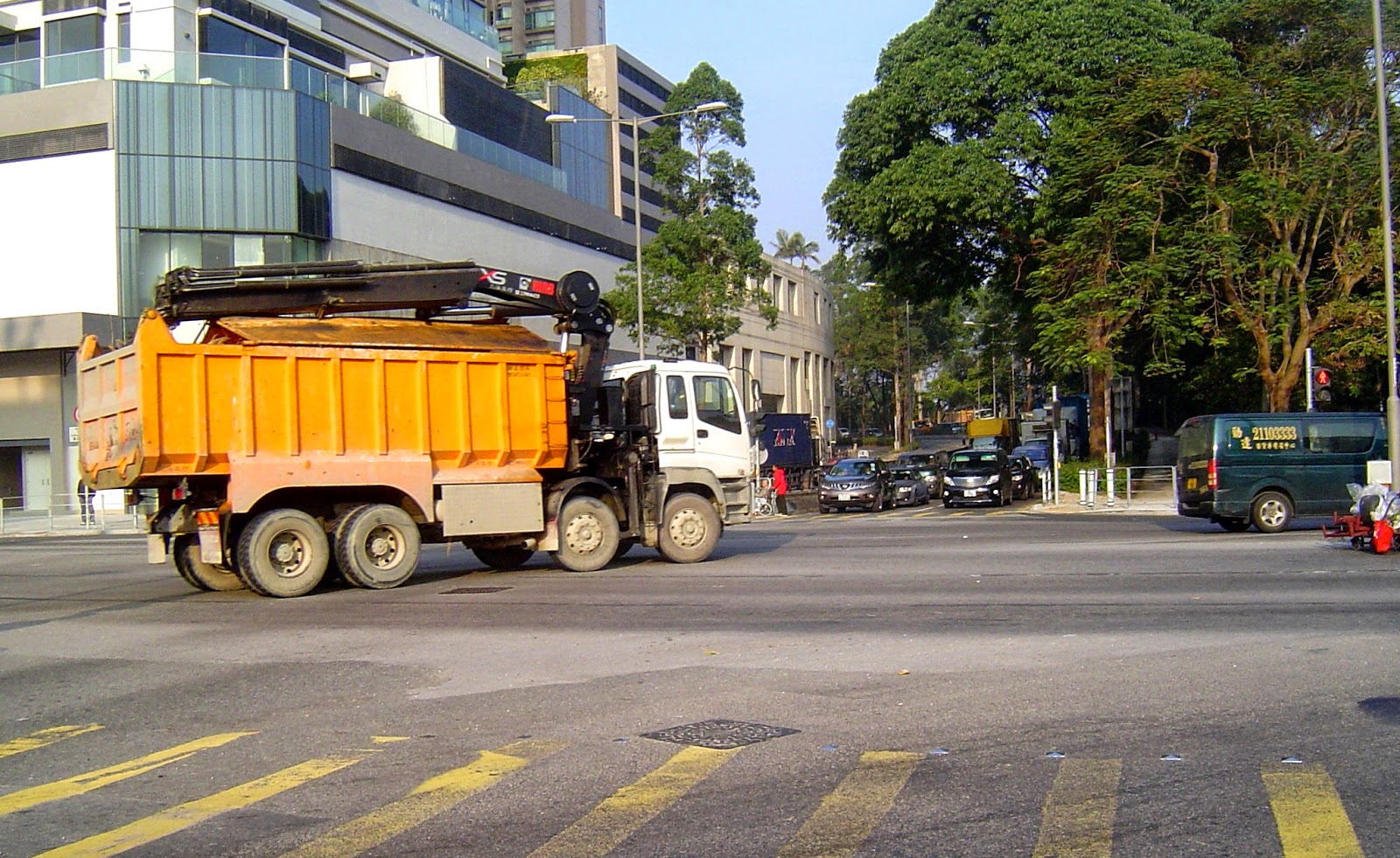
If this had been my only criticism of the changes, it could plausibly be argued that one problem had been resolved (turning right from the northeast), and the replacement problem is not as serious. However, there has been another consequence of the changes that is dangerous and that needs to be addressed urgently. Traffic from the southeast, which will have come through Fanling’s industrial district, continues to pour out of the unnamed road up to 15 seconds after the lights have turned red! Some of this traffic is 40-foot container trucks, and some is smaller freight vehicles, but this lawless flow also includes coaches, minibuses and private cars, a point that I will return to presently.
This phenomenon (see photos below) only occurs during peak periods; during the day, there is sufficient time for all the traffic that is waiting its turn to get through the junction while the signal remains at green. This nonchalant red-light jumping is new; it never happened under the old system, and I think I know why.
Note that under the old system, phase #4 (traffic from the southeast) was followed by a universal pedestrian phase, so within a second or so of the little green men appearing on eight separate crossings, the junction was swarming with pedestrians and cyclists, many of whom were crossing the junction diagonally. Even an inveterate runner of red lights would think twice before finding themselves having to explain how they came to knock down several people who had decided to cross on the quite reasonable expectation that they wouldn’t encounter any traffic because all the little men were green.
Unfortunately, this incentive to stay behind the stop line once the red light has appeared no longer seems to apply, because traffic from the southwest, whose turn it should be, can be relied upon to wait patiently until the illicit backlog has cleared. But why should this behaviour have developed? And why is it so blatant? I return to an analysis of the traffic types, particularly the cars, coaches and minibuses, that emerge from this road. Where have they come from?
Anyone driving up from the south or from the other side of the railway, if they are not familiar with the lie of the land, will follow the conventional, signposted route, which involves turning right onto Sha Tau Kok Road at a light-controlled junction that isn’t particularly generous with the time allotted to traffic wanting to make this manœuvre. Driving through the industrial district avoids this junction, and a second set of traffic lights, before joining Sha Tau Kok Road. Clearly, such drivers have already developed a time-saving mindset, which translates into thinking that they still have time to cross the junction even though the light turned red several seconds ago.
This system has now been in operation for several months, and I would be astounded if the police were unaware of the current situation. But this would imply that they do know yet choose to do nothing about it. And what about the anonymous official who designed this new light sequence? Surely they would have been aware that the road through the industrial district is used as a rat run by local drivers and should thus have anticipated the possibility that those same drivers might disregard the lights. And did anyone think to tell the police, and/or the Highways Department, that the sequence had been changed and could someone monitor the situation for problems?
Soon after deciding to write about this phenomenon, I happened to see a public service announcement (PSA) on one of the local television channels reminding drivers that ‘we stop on amber’ and warning them that they faced a $500 fine (and five penalty points on their licence) for running a red light. In Breaking the Law, I highlighted the strange situation that exists on public minibuses, where passengers are warned that they face a fine of $5,000 (and three months in prison) if they fail to fasten their seat belts. Both warnings are equally often ignored, but it does seem bizarre that the authorities regard an act of stupidity that can only impact on the perpetrator as being ten times more serious than an act of stupidity that can result in someone else being killed.
Public transport between my village and Fanling railway station is inadequate at peak times, so every weekday morning around 8 o’clock I drive Paula to the station. Once we have joined Sha Tau Kok Road, the first junction we encounter is the one shown in the following diagram, to which I’ve added compass points for the four roads feeding into the junction to make the problem easier to describe.
Work to modify the layout at this junction had been in progress throughout last winter and was finally completed during the summer. Basically, all that has been added are left-turn lanes from Sha Tau Kok Road in both directions, and the right-turn lane from the northeast has been lengthened. However, in the original layout, locals driving from the northeast knew to join the much longer queue in the left-hand lane, because the right-hand lane was blocked by traffic waiting to turn right. Curing this problem is the likely motive for changing the light sequence, but this has had unexpected consequences.
To illustrate the problem, I need to compare the old and the new light sequences. This is the old sequence:
1. Traffic from NE (left turn and straight ahead only); traffic from SW*.And this is the new:
2. All traffic from NE; traffic from NW (left turn only).
3. All traffic from NW.
4. All traffic from SE.
5. Universal pedestrian phase†.
* Turning right is forbidden if coming from the southwest.
† This phase is activated only if someone presses the button—a given at this junction.
1. All traffic from NE.There is no universal pedestrian phase in the new sequence, so pedestrians and cyclists negotiating this junction have to do so piecemeal, which is especially frustrating if your eventual destination is diagonally opposite your starting point. However, the first flaw in this arrangement drew my attention immediately: up to 90 percent of the traffic from the northwest, southeast and southwest (phases #2–#4) exits the junction to the northeast, and the next set of traffic lights is only about 300 metres away. Although the lights at this next junction are heavily biased towards traffic on the main road, here the pedestrian phase—if somebody has pressed the button—is quite long, and when this occurs traffic invariably backs up and clogs the junction that is the subject of this analysis.
2. All traffic from NW.
3. All traffic from SE.
4. All traffic from SW (right turn prohibited).
If this had been my only criticism of the changes, it could plausibly be argued that one problem had been resolved (turning right from the northeast), and the replacement problem is not as serious. However, there has been another consequence of the changes that is dangerous and that needs to be addressed urgently. Traffic from the southeast, which will have come through Fanling’s industrial district, continues to pour out of the unnamed road up to 15 seconds after the lights have turned red! Some of this traffic is 40-foot container trucks, and some is smaller freight vehicles, but this lawless flow also includes coaches, minibuses and private cars, a point that I will return to presently.
This phenomenon (see photos below) only occurs during peak periods; during the day, there is sufficient time for all the traffic that is waiting its turn to get through the junction while the signal remains at green. This nonchalant red-light jumping is new; it never happened under the old system, and I think I know why.
Note that under the old system, phase #4 (traffic from the southeast) was followed by a universal pedestrian phase, so within a second or so of the little green men appearing on eight separate crossings, the junction was swarming with pedestrians and cyclists, many of whom were crossing the junction diagonally. Even an inveterate runner of red lights would think twice before finding themselves having to explain how they came to knock down several people who had decided to cross on the quite reasonable expectation that they wouldn’t encounter any traffic because all the little men were green.
Unfortunately, this incentive to stay behind the stop line once the red light has appeared no longer seems to apply, because traffic from the southwest, whose turn it should be, can be relied upon to wait patiently until the illicit backlog has cleared. But why should this behaviour have developed? And why is it so blatant? I return to an analysis of the traffic types, particularly the cars, coaches and minibuses, that emerge from this road. Where have they come from?
Anyone driving up from the south or from the other side of the railway, if they are not familiar with the lie of the land, will follow the conventional, signposted route, which involves turning right onto Sha Tau Kok Road at a light-controlled junction that isn’t particularly generous with the time allotted to traffic wanting to make this manœuvre. Driving through the industrial district avoids this junction, and a second set of traffic lights, before joining Sha Tau Kok Road. Clearly, such drivers have already developed a time-saving mindset, which translates into thinking that they still have time to cross the junction even though the light turned red several seconds ago.
This sequence of photos illustrates the difficulty of adequately recording this phenomenon. You have only my word that the black van in the first photo was behind the stop line when the light turned to red. It could have just turned, making this vehicle's position legitimate. However, it is easy to deduce that the yellow truck would have been crossing the stop line as the light changed. So where does that leave the driver of the black car in the third photo, who would have had more than enough time to stop?
This system has now been in operation for several months, and I would be astounded if the police were unaware of the current situation. But this would imply that they do know yet choose to do nothing about it. And what about the anonymous official who designed this new light sequence? Surely they would have been aware that the road through the industrial district is used as a rat run by local drivers and should thus have anticipated the possibility that those same drivers might disregard the lights. And did anyone think to tell the police, and/or the Highways Department, that the sequence had been changed and could someone monitor the situation for problems?
Soon after deciding to write about this phenomenon, I happened to see a public service announcement (PSA) on one of the local television channels reminding drivers that ‘we stop on amber’ and warning them that they faced a $500 fine (and five penalty points on their licence) for running a red light. In Breaking the Law, I highlighted the strange situation that exists on public minibuses, where passengers are warned that they face a fine of $5,000 (and three months in prison) if they fail to fasten their seat belts. Both warnings are equally often ignored, but it does seem bizarre that the authorities regard an act of stupidity that can only impact on the perpetrator as being ten times more serious than an act of stupidity that can result in someone else being killed.
Thursday, 1 January 2015
photographic abstraction #13
For my latest series of abstract images, I’ve increased the contrast and colour saturation of the original images well beyond the amount I usually apply, apart from Slime #2, which, unsurprisingly, comes from the same source as Slime #1 (Photographic Abstraction #11). I think you will agree that the effects are striking, although whether that is sufficient to validate these images as art is not for me to judge.
recent posts in this series
Photographic Abstraction #9
Photographic Abstraction #10
Photographic Abstraction #12
bright lights, big city
frozen
slime #2
red dwarf
kaleidoscope
recent posts in this series
Photographic Abstraction #9
Photographic Abstraction #10
Photographic Abstraction #12
Labels:
art,
photography
Wednesday, 31 December 2014
an english question
The last day of yet another year, a year that seems to have passed by even more quickly than the previous year, and it’s time for another connection puzzle. The title of this post is intended to warn American readers that some knowledge of British geography, history and culture will be needed to solve it, but even then it might give you a bigger headache than the alcohol you’ve probably been drinking this evening.
As usual, I will acknowledge all correct answers, but I won’t actually publish an answer for a few weeks, to give other readers a chance to work it out for themselves.
similar puzzles
A Hard Question
What’s the Connection?
Odd One Out
How might contemplating the force of the wind lead you to think aboutIf you haven’t seen this kind of puzzle before, you need to turn what are general clues into specific answers. For example, is the mediæval English city Canterbury? York? Oxford? Cambridge? Or somewhere else? The correct overall answer can only be found by comparing lists of answers for the individual clues, but once you have a match between two clues, the rest should fall into place quite easily.
• an English bay;
• an English palace;
• a northern English town;
• a mediæval English city; and
• a former British prime minister?
As usual, I will acknowledge all correct answers, but I won’t actually publish an answer for a few weeks, to give other readers a chance to work it out for themselves.
similar puzzles
A Hard Question
What’s the Connection?
Odd One Out
Labels:
puzzles
Subscribe to:
Posts (Atom)


