Although I’ve been posting collections of what I consider to be the best photographs taken each summer in the UK for several years, I didn’t do so last year because just five photos met my criteria for inclusion. I haven’t done much better this year, but here are my combined favourites from the past two years.
2020
The first photo is of a spider’s web in the garden of our house in Penrith:
The next photo shows a red admiral butterfly on a marsh orchid. It was taken on a short path that runs alongside the railway close to our house:
A few years ago, a flowering plant appeared on broken ground and in cracks in walls in several locations around Penrith that I’d never seen before. I eventually identified it as purple toadflax (Linaria purpurea), and this is the last example that I’ve seen:
It seems to have disappeared from the scene as quickly as it appeared.
I can’t remember where I photographed this spectacular bracket fungus:
I hadn’t originally considered the next photo for inclusion in a highlights package, but there are certainly enough sheep to send you to sleep if you try to count them:
I took the following image while out cycling north of Penrith. It shows quite a rare atmospheric phenomenon: laminar flow. Airflow in the atmosphere is usually turbulent.
The next image is taken from a photo of a larger group of cows, and it became interesting only when I cropped it out and enlarged it:
They do look intently serious!
The final photo for 2020 shows an unidentified species of bird that had just crashed into a window in our house and is lying next to our back door, clearly dazed. I took the photo solely because of the impressive wing patterns:
It did fly off a few minutes later.
2021
Although we were able to get out as and when we wanted this summer, I still didn’t take as many photos as in previous years. Here are what I consider to be the most interesting.
Our house in Penrith is part of a Victorian terrace, and the first photo is a view of the rooftops of the next street as seen from our back door. It was taken by Paula and shows what I think is a large gathering of starlings:
You are much more likely to see jackdaws here.
We walked or cycled past Brougham Castle, a mile or so southeast of Penrith, several times this summer, and I took several photos. This is the best:
What you can see dates to the beginning of the fourteenth century, and the castle was a ruin by the seventeenth century. The name is an Anglo-Norman corruption of the Latin ‘Brocavum’—the Romans originally built a fort on this site almost 2,000 years ago to guard the river crossing (the river is the Eamont).
Incidentally, unless you’re from this area, you probably won’t be able to pronounce the castle’s name correctly, and if you’d like to try your hand at the pronunciation of English place names, see Peculiar Pronouncements, where ‘Brougham’ is part of a test that I devised.
You don’t see many milestones nowadays, but this one has probably survived because it’s located on an old section of the A66 near the castle that is no longer used except for local access. In fact, you cannot reach Appleby by car if you follow the directions here:
Brougham Hall, a fortified manor house of a similar age to the castle, is located nearby. This is a door knocker that I photographed on the outside:
Penrith has a large population of gulls, and I photographed this pair of newly fledged youngsters taking a breather at what struck me as a not particularly safe location next to Sainsbury’s supermarket. You can tell that they’re young because they haven’t yet developed their adult plumage:
We did a lot of cycling this summer, most of which was on roads and through villages that I’d never visited before. However, I’d never even heard of three of the villages named on this signpost (Ivegill lies on a long-established cycling route):
However, that isn’t the reason I took the photo. Note the discrepancy in spelling between the directional signpost and the sign proclaiming the entrance to the village of Gaitsgill. The latter is clearly of a much later date, because the signpost was erected by Cumberland County Council, which ceased to exist in 1974.
Graffiti are not something you see much of in Penrith, but I thought that the alteration to this sign at the entrance to a residential area on the southwestern edge of town was quite amusing:
A few days before heading back to Hong Kong, we visited the Victorian seaside town of Silloth with a couple of friends. We were struck by this imposing example of public art on the town’s promenade, which has been constructed from narrow strips of mild steel welded together:
The title of the work, which looks over the Solway Firth towards Galloway in Scotland, is ‘Look at that View’.
Tuesday, 28 September 2021
Wednesday, 22 September 2021
a walk on the wild side
Although cycling has been our principal activity this summer, Paula and I have usually gone for a walk on the days when we’ve not been cycling. Most of these walks have been short, just a couple of miles, but one day recently, Paula told me that she wanted to do a longer walk. I decided immediately on an appropriate route.
A few years ago, we’d followed a path leading from Eamont Bridge, a small village that straddles the middle of the three road crossings of the River Eamont about a mile south of Penrith. That seemed like an ideal choice. I documented a walk along this river, also starting in Eamont Bridge, in Water from the Mountains, but that walk followed the river downstream on the north side. Our intended route this time started on the south side of the bridge and, while not actually following the river, headed in a general upstream direction.
Because we hadn’t come this way for quite a few years, I didn’t recognize anything, which probably explains why, when we arrived in Yanwath, a small hamlet next to the railway, it was at a different point from the one I remembered. However, while we’d walked along the main road to the next village, Tirril, the last time we came this way, on this occasion we spotted a signpost indicating a public footpath to Sockbridge Mill, and Sockbridge is a hamlet that is contiguous with Tirril, so we followed it.
At first, the path followed the edge of fields, but after a short distance, we came to a stile that led into the narrow wooded area on the banks of the river. I hadn’t planned to document the entire route, but the path was quite tricky to negotiate, so I took the following photos of Paula, who was walking ahead of me:
We eventually reached a footbridge across the river, which led to a footpath that we could follow back to Penrith. I took two photographs from the footbridge, first looking upstream:
…then downstream:
Note the low water level, the result of an exceptionally dry summer, although this river is capable of unleashing catastrophic floods.
There isn’t much to see on the return footpath, except where it crosses the railway via a pair of tunnels:
These tunnels probably date back to 1846, when the original line through Penrith was opened by the Lancaster and Carlisle Railway, which almost immediately became a small part of the much larger London and North Western Railway. The first tunnel passes underneath a loop once used by goods trains to allow the much faster passenger trains to overtake. I can still recall seeing old LNWR steam locomotives, which we nicknamed ‘grunts’, waiting in this loop in the early 1960s, so they would have been pretty ancient by then (the LNWR had become a part of the London Midland and Scottish Railway in 1923). This procedure is probably unnecessary on the modern railway system, which no longer carries slow goods trains, although I don’t know whether the rails have now been lifted. This is a closer look at the entrance to the second tunnel, which passes underneath the main line:
A good example of solid Victorian engineering/workmanship.
And that was our ‘longer walk’, although we still had to negotiate junction 40 on the M6 motorway, which is quite a tedious exercise nowadays for pedestrians.
A few years ago, we’d followed a path leading from Eamont Bridge, a small village that straddles the middle of the three road crossings of the River Eamont about a mile south of Penrith. That seemed like an ideal choice. I documented a walk along this river, also starting in Eamont Bridge, in Water from the Mountains, but that walk followed the river downstream on the north side. Our intended route this time started on the south side of the bridge and, while not actually following the river, headed in a general upstream direction.
Because we hadn’t come this way for quite a few years, I didn’t recognize anything, which probably explains why, when we arrived in Yanwath, a small hamlet next to the railway, it was at a different point from the one I remembered. However, while we’d walked along the main road to the next village, Tirril, the last time we came this way, on this occasion we spotted a signpost indicating a public footpath to Sockbridge Mill, and Sockbridge is a hamlet that is contiguous with Tirril, so we followed it.
At first, the path followed the edge of fields, but after a short distance, we came to a stile that led into the narrow wooded area on the banks of the river. I hadn’t planned to document the entire route, but the path was quite tricky to negotiate, so I took the following photos of Paula, who was walking ahead of me:
We eventually reached a footbridge across the river, which led to a footpath that we could follow back to Penrith. I took two photographs from the footbridge, first looking upstream:
…then downstream:
Note the low water level, the result of an exceptionally dry summer, although this river is capable of unleashing catastrophic floods.
There isn’t much to see on the return footpath, except where it crosses the railway via a pair of tunnels:
These tunnels probably date back to 1846, when the original line through Penrith was opened by the Lancaster and Carlisle Railway, which almost immediately became a small part of the much larger London and North Western Railway. The first tunnel passes underneath a loop once used by goods trains to allow the much faster passenger trains to overtake. I can still recall seeing old LNWR steam locomotives, which we nicknamed ‘grunts’, waiting in this loop in the early 1960s, so they would have been pretty ancient by then (the LNWR had become a part of the London Midland and Scottish Railway in 1923). This procedure is probably unnecessary on the modern railway system, which no longer carries slow goods trains, although I don’t know whether the rails have now been lifted. This is a closer look at the entrance to the second tunnel, which passes underneath the main line:
A good example of solid Victorian engineering/workmanship.
And that was our ‘longer walk’, although we still had to negotiate junction 40 on the M6 motorway, which is quite a tedious exercise nowadays for pedestrians.
Labels:
adventure,
cumbria,
photography,
railways
Saturday, 28 August 2021
the border city
I don’t often visit Carlisle, the largest conurbation in Cumbria and the county’s only city, unless I have an appointment of some kind. That was certainly the case a few days ago, when Paula had a routine medical appointment at the Cumberland Infirmary. We thought that it would be a chance to look around, because I knew that there were one or two places of interest.
On our way back to the city centre, the first point of interest that we encountered was a church that appears to function no longer as a place of worship:
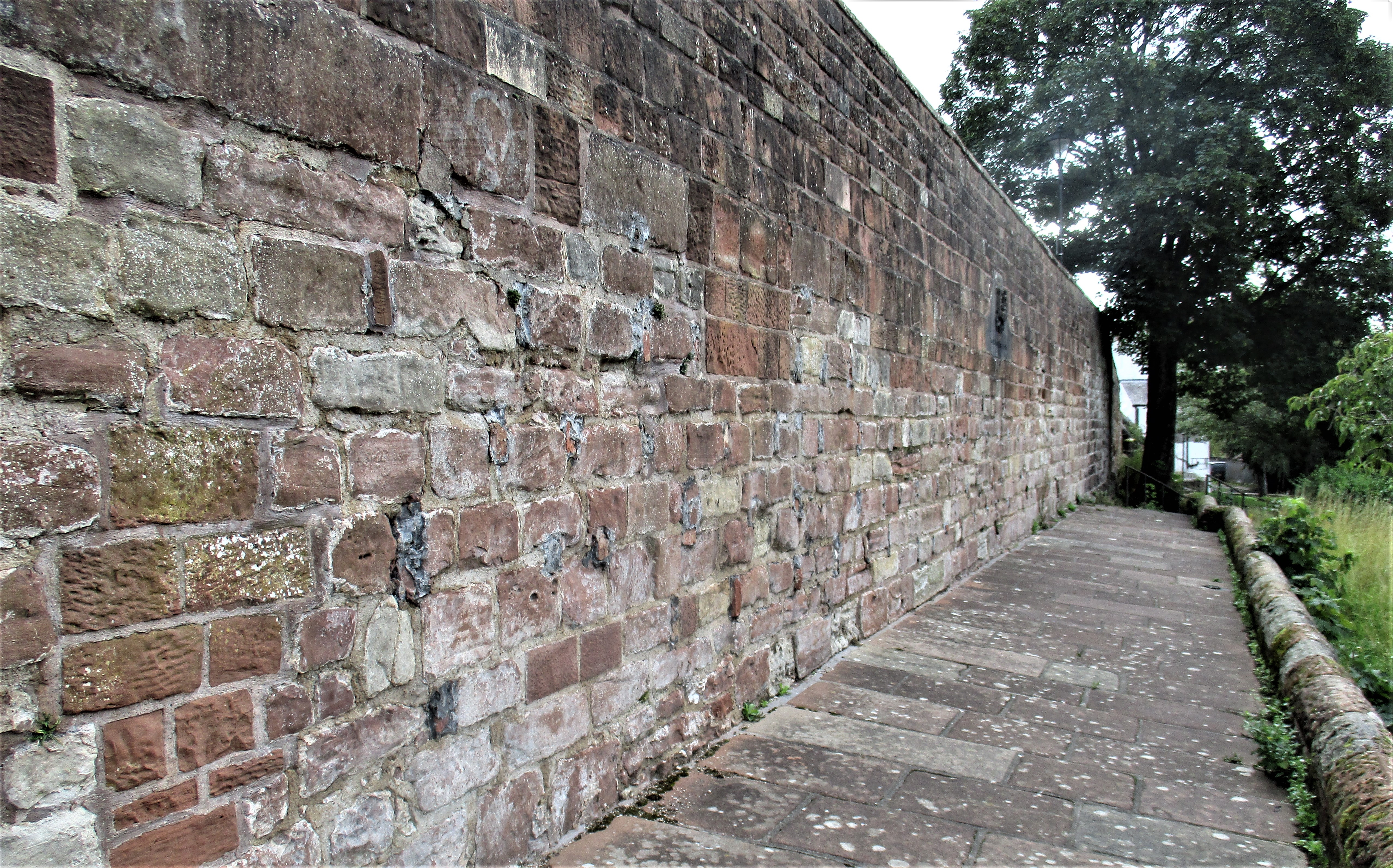
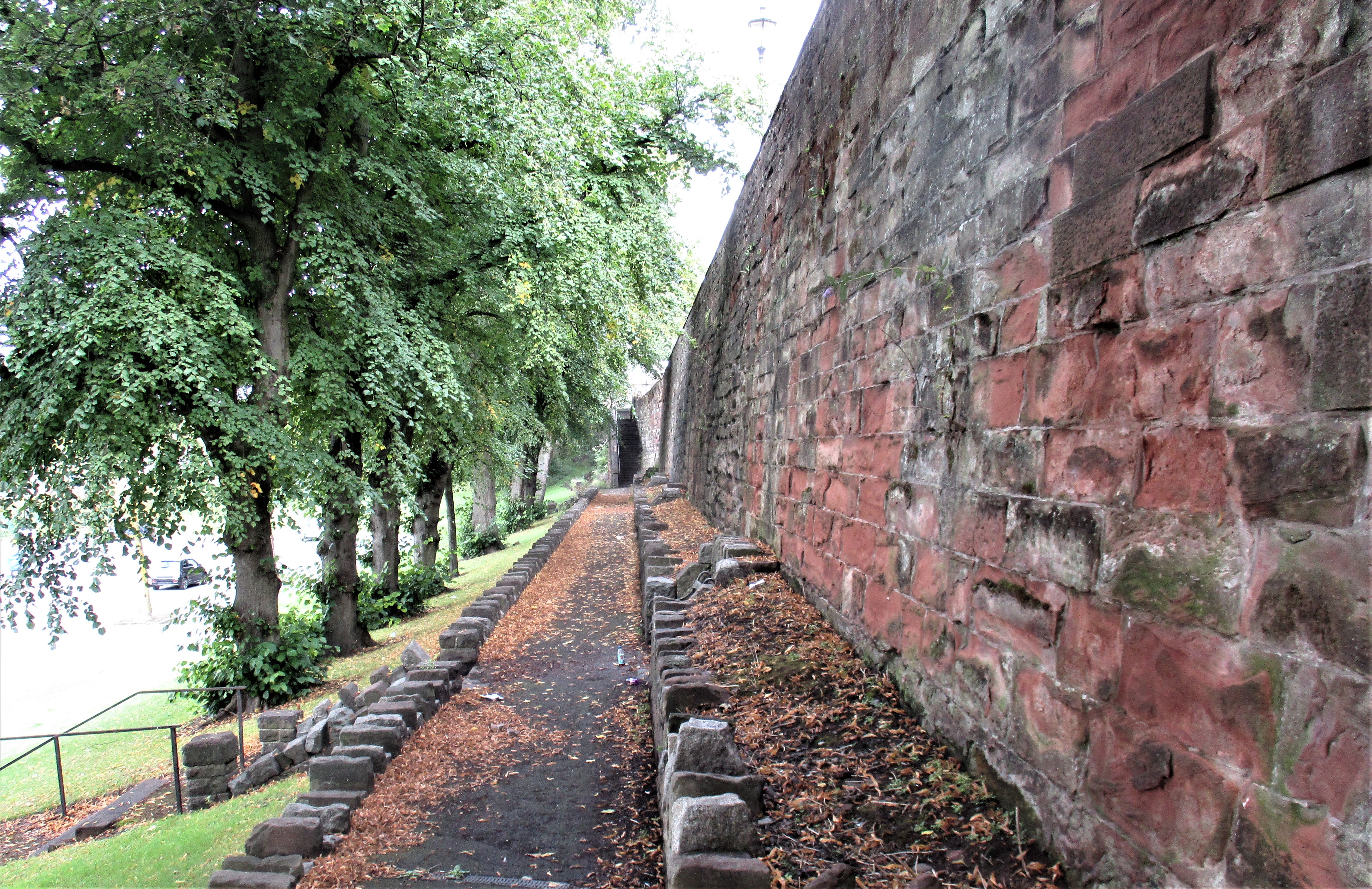
We then followed the outside of what remains of the mediƦval city walls:
There were a couple of stone plaques set into the wall, which suggests that these walls were rebuilt at some time in the nineteenth century:
We eventually found a flight of steps that leads to the city’s cathedral. There has been a cathedral on this site since the twelfth century, although I am unable to say how much of the structure that you can see today dates back to this period. The architectural style is Gothic, but when we went inside, I couldn’t help but notice several Romanesque arches at ground level in the area directly beneath the bell tower.
Here are two photos taken inside the cathedral:
The first, taken by Paula, shows the cathedral’s organ, while the second shows the east window. This is what the east window looks like from the outside:
…and these are two other views of the building:
While we were photographing the outside of the building, several people asked us whether we’d seen the policeman. It took us a while to find him, but you can see him in the following photo, a finial on the end of the architrave above the window:
Apparently, this finial commemorates the first policeman ever to lose his life in the line of duty.
All the external shots of the cathedral were taken by Paula.
Having seen everything there is to see in the vicinity of the cathedral, it was time to find somewhere to eat. Paula said that she’d seen some dining places next to ‘the castle’. We’d walked past Carlisle Castle on our way from the bus station to the hospital, and it wasn’t too far away. I didn’t recall seeing anywhere thereabouts to eat, but we headed in that direction anyway. I didn’t realize that when Paula had said ‘the castle’, she was actually referring to the city’s law courts, which are located next to the railway station. You can see the station in the background in the next photo, and you can also see why Paula thought that the law courts were actually a ‘castle’, with their crenellated walls and general quasi-mediƦval appearance:
Meanwhile, we walked through Bitt’s Park, the largest urban park in the city, where I spotted these two mosaic ‘armchairs’:
Finally, on our way back to the city centre, we passed a spectacular mural:
It appears to show a Roman gladiator battling an unspeakable demon, although I do wonder whether it is allegorical, and that what you can see is an ordinary Roman soldier fighting off one of the barbarians that lived to the north and repeatedly raided the area south of the nominal border at the time (Emperor Hadrian had a wall constructed from coast to coast to keep out the aforementioned barbarians).
While I was photographing the mural, a woman walking past said this:
“Brilliant, isn’t it? It was painted by a student at the local art college.”
I couldn’t find a signature on the mural, but I agree with the woman’s assessment. I’ve recorded quite a lot of street art in Hong Kong, but this mural is even more impressive than anything I’ve seen there (cf. Tunnel Vision; Down by the Riverside; Latest News from Ghost Alley #2; Fish out of Water).
And that was our brief tour of Carlisle. We found somewhere for a late lunch, then caught the next bus back to Penrith.
We then followed the outside of what remains of the mediƦval city walls:
There were a couple of stone plaques set into the wall, which suggests that these walls were rebuilt at some time in the nineteenth century:
We eventually found a flight of steps that leads to the city’s cathedral. There has been a cathedral on this site since the twelfth century, although I am unable to say how much of the structure that you can see today dates back to this period. The architectural style is Gothic, but when we went inside, I couldn’t help but notice several Romanesque arches at ground level in the area directly beneath the bell tower.
Here are two photos taken inside the cathedral:
The first, taken by Paula, shows the cathedral’s organ, while the second shows the east window. This is what the east window looks like from the outside:
…and these are two other views of the building:
While we were photographing the outside of the building, several people asked us whether we’d seen the policeman. It took us a while to find him, but you can see him in the following photo, a finial on the end of the architrave above the window:
Apparently, this finial commemorates the first policeman ever to lose his life in the line of duty.
All the external shots of the cathedral were taken by Paula.
Having seen everything there is to see in the vicinity of the cathedral, it was time to find somewhere to eat. Paula said that she’d seen some dining places next to ‘the castle’. We’d walked past Carlisle Castle on our way from the bus station to the hospital, and it wasn’t too far away. I didn’t recall seeing anywhere thereabouts to eat, but we headed in that direction anyway. I didn’t realize that when Paula had said ‘the castle’, she was actually referring to the city’s law courts, which are located next to the railway station. You can see the station in the background in the next photo, and you can also see why Paula thought that the law courts were actually a ‘castle’, with their crenellated walls and general quasi-mediƦval appearance:
Meanwhile, we walked through Bitt’s Park, the largest urban park in the city, where I spotted these two mosaic ‘armchairs’:
Finally, on our way back to the city centre, we passed a spectacular mural:
It appears to show a Roman gladiator battling an unspeakable demon, although I do wonder whether it is allegorical, and that what you can see is an ordinary Roman soldier fighting off one of the barbarians that lived to the north and repeatedly raided the area south of the nominal border at the time (Emperor Hadrian had a wall constructed from coast to coast to keep out the aforementioned barbarians).
While I was photographing the mural, a woman walking past said this:
“Brilliant, isn’t it? It was painted by a student at the local art college.”
I couldn’t find a signature on the mural, but I agree with the woman’s assessment. I’ve recorded quite a lot of street art in Hong Kong, but this mural is even more impressive than anything I’ve seen there (cf. Tunnel Vision; Down by the Riverside; Latest News from Ghost Alley #2; Fish out of Water).
And that was our brief tour of Carlisle. We found somewhere for a late lunch, then caught the next bus back to Penrith.
Labels:
art,
cumbria,
history,
photography,
religion
Saturday, 31 July 2021
a fire in the night
There are few words and phrases to which revulsion is an almost instinctive reflex, where the idea behind the word or phrase is so repugnant that the reaction of most people is to avert their eyes and nervously change the subject. Although most concepts are capable of bearing more than one interpretation, of being evaluated from more than one point of view, some ideas are so far beyond the limits of basic human decency that outrage is the only acceptable human response.
Terrorism is one such word. It’s not a word that people want to hear; it’s not an activity that they want to hear about. It’s someone else’s problem. But there is a price to pay for drawing the curtains and pretending that you can shut out the world, because if you don’t understand a problem, then you cannot begin to understand how to solve it.
American presidents, who are in the best position to attempt such a solution, clearly do not try to shut out the world. They don’t need to. They can do very much whatever they want to do. Whatever they want to do in terms of direct action, that is. In terms of action that is designed to achieve a given end, the record is less impressive. The American military juggernaut may have squashed the al-Qaeda training camps and toppled the hated Taliban from power in Afghanistan in 2001, but this has done nothing to weaken support for al-Qaeda by the poor and oppressed throughout the Middle East. How could it? To combat terrorism, you first have to understand why it happens, which American leaders have singularly failed to do. This is not to excuse the use of random violence, in any circumstances. There is no excuse.
That is to say, there is no excuse from the comfort of our middle-class armchairs. But place yourself in the mind of a young Palestinian: late teens; limited education; no job prospects; surrounded by fanatical clerics. The Israeli Army plays its part in moulding the finished product as it brutalizes the populations of the West Bank and Gaza, tearing down the houses of suspected militants, targeting known militants for summary execution, and arresting whomsoever it pleases. The clerics wouldn’t have to try too hard to convince such a young man who their enemy was and—the next logical step—how best to fight back.
Thus far, I’ve not attempted to actually define terrorism. Most people believe that they can recognize the phenomenon when they see it. Surprisingly, however, a definition that satisfies all parties to the debate is more elusive than you might think. The attacks on the World Trade Center and the Pentagon on 11th September 2001 were clearly acts of terrorism, but this is an extreme case and so is easy to categorize. However, although terrorism may be easy to recognize in its most extreme manifestations, where the moral imperative behind the action is as abhorrent to the vast majority as the action itself, you will quickly become submerged in a morass of moral relativism and conflicting interpretations of the same event once you move away from the simple distinctions of those extremes.
At the opposite pole to the attacks by al-Qaeda on the United States, the assassination of Archduke Franz Ferdinand in Sarajevo in 1914 by Gavrilo Princip, a Bosnian Serb nationalist, precipitated the greatest war in the history of the human race to that time and could also be categorized as an act of terrorism, if we take terrorism to include the targeted murder of a public figure by members of a dissident group.
However, if we accept this partial definition, what are we to make of the assassination of Reinhard Heydrich by Czech partisans in Prague in 1940? Few would fail to applaud such an action, even though in the event it cost the existence of the village of Lidice and its inhabitants. It is important to see the distinction between these two examples, because it illustrates the definitional quagmire that we are on the point of falling into. It is this: if we applaud the assassination of the Nazi gauleiter, then we are saying in effect that anything is permissible provided that the cause is just. But who defines the justice of a cause? The only moral position that one can take in such a situation is that nothing justifies murder, however acute the grievance, but then you would have to be prepared to die for such a belief. That takes a lot of doing, but as we are all learning to our cost, some are indeed prepared to do precisely that, even if it involves the death of hundreds of innocent bystanders.
Terrorism is one such word. It’s not a word that people want to hear; it’s not an activity that they want to hear about. It’s someone else’s problem. But there is a price to pay for drawing the curtains and pretending that you can shut out the world, because if you don’t understand a problem, then you cannot begin to understand how to solve it.
American presidents, who are in the best position to attempt such a solution, clearly do not try to shut out the world. They don’t need to. They can do very much whatever they want to do. Whatever they want to do in terms of direct action, that is. In terms of action that is designed to achieve a given end, the record is less impressive. The American military juggernaut may have squashed the al-Qaeda training camps and toppled the hated Taliban from power in Afghanistan in 2001, but this has done nothing to weaken support for al-Qaeda by the poor and oppressed throughout the Middle East. How could it? To combat terrorism, you first have to understand why it happens, which American leaders have singularly failed to do. This is not to excuse the use of random violence, in any circumstances. There is no excuse.
That is to say, there is no excuse from the comfort of our middle-class armchairs. But place yourself in the mind of a young Palestinian: late teens; limited education; no job prospects; surrounded by fanatical clerics. The Israeli Army plays its part in moulding the finished product as it brutalizes the populations of the West Bank and Gaza, tearing down the houses of suspected militants, targeting known militants for summary execution, and arresting whomsoever it pleases. The clerics wouldn’t have to try too hard to convince such a young man who their enemy was and—the next logical step—how best to fight back.
Thus far, I’ve not attempted to actually define terrorism. Most people believe that they can recognize the phenomenon when they see it. Surprisingly, however, a definition that satisfies all parties to the debate is more elusive than you might think. The attacks on the World Trade Center and the Pentagon on 11th September 2001 were clearly acts of terrorism, but this is an extreme case and so is easy to categorize. However, although terrorism may be easy to recognize in its most extreme manifestations, where the moral imperative behind the action is as abhorrent to the vast majority as the action itself, you will quickly become submerged in a morass of moral relativism and conflicting interpretations of the same event once you move away from the simple distinctions of those extremes.
At the opposite pole to the attacks by al-Qaeda on the United States, the assassination of Archduke Franz Ferdinand in Sarajevo in 1914 by Gavrilo Princip, a Bosnian Serb nationalist, precipitated the greatest war in the history of the human race to that time and could also be categorized as an act of terrorism, if we take terrorism to include the targeted murder of a public figure by members of a dissident group.
However, if we accept this partial definition, what are we to make of the assassination of Reinhard Heydrich by Czech partisans in Prague in 1940? Few would fail to applaud such an action, even though in the event it cost the existence of the village of Lidice and its inhabitants. It is important to see the distinction between these two examples, because it illustrates the definitional quagmire that we are on the point of falling into. It is this: if we applaud the assassination of the Nazi gauleiter, then we are saying in effect that anything is permissible provided that the cause is just. But who defines the justice of a cause? The only moral position that one can take in such a situation is that nothing justifies murder, however acute the grievance, but then you would have to be prepared to die for such a belief. That takes a lot of doing, but as we are all learning to our cost, some are indeed prepared to do precisely that, even if it involves the death of hundreds of innocent bystanders.
Subscribe to:
Posts (Atom)