Friday, 15 October 2021

liberation day

At the age of 75, I shouldn’t expect to be doing something for the first time in my life, but I’ve just spent the last 21 days in a single room, never once venturing beyond its door. That door was never locked, but had I decided to leave the confines of this 3×4-metre box, I would have been liable to a fine of up to HK$25,000 and imprisonment for six months.

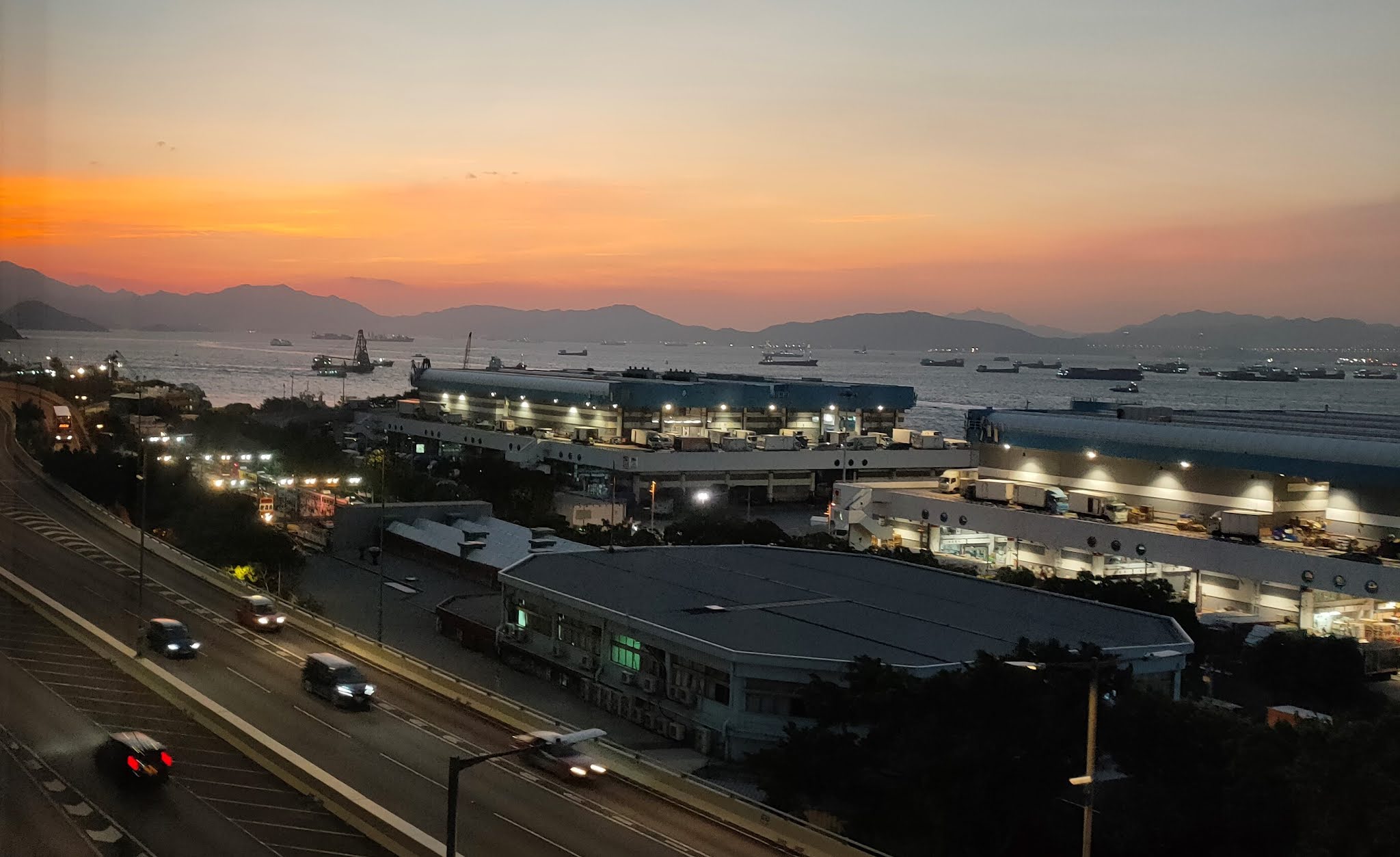
At least the room has a good view, because it overlooks the western approaches to Hong Kong’s harbour. Consequently, with little else to do, I’ve been taking quite a few photos. A short selection follows, starting with a general view looking northeast:
Ferries make up the majority of traffic on the water, and there are three, operated by different companies, in this image.

I took the next photo to record the cloud nestled around the summit of the mountain in the background. This mountain is Tai Mo Shan (‘big mist mountain’), the highest in Hong Kong at 957 metres (3,140 feet) above sea level:
This photo also shows the spectacular suspension bridge that connects Stonecutters Island (on the right) and Tsing Yi. Incidentally, given the shortage of building space in Hong Kong, you may safely conclude that the buildings in the foreground of this image are a government facility. They are in fact part of a wholesale food market complex.

The next two photos were taken with my camera’s telephoto function to show more details of the bridge:
Hong Kong’s container terminal can be seen behind the right-hand approach to the bridge.

I took the next photo to show a ferry overtaking a barge carrying shipping containers, but it also shows Lion Rock, the imposing summit cliff on the rightmost hill in the background:
The following two photos were taken late on the same afternoon, looking east and west, respectively:
…while this photo was taken on a subsequent late afternoon, looking northwest:
However, this is my best sunset picture:
…while this is another view of the bridge, taken a short time later:
Notice that the weather, as reflected in all the above photos, has mostly been fine, but a tropical cyclone, Typhoon Kompasu, passed 200km south of Hong Kong a couple of days ago. And this is what the view to the east looked like at one point during this event, which prompted the issuing of a #8 typhoon warning (gale force winds expected, all schools closed) by the Hong Kong Observatory:
Finally, this is a view of a section of the food market at 5 o’clock in the morning:
Notice the line of red taxis in front of the food market. I initially thought that this was an odd place for a taxi rank, but the taxis are in fact queuing for the specialist filling station that you can see on the right—all taxis (and minibuses) in Hong Kong run on natural gas!
*  *  *
As you can probably imagine, being confined to a single room with no freedom of movement whatsoever is extremely boring. The relentless tedium of the past three weeks has been punctuated only by the meals provided, which were, for the most part, something to look forward to.

Although the lunch/dinner menu changed every five days, the breakfast menu remained unchanged throughout our incarceration: a choice between an ‘American’ breakfast; a Chinese breakfast; and a ‘healthy option’. I was not impressed by the last of these, but this is a photo of a typical ‘American’ breakfast, which I chose on several occasions:
However, my breakfast of choice was the Chinese breakfast, even though the dim sum selection, in particular, was barely lukewarm by the time it was delivered to our room. The chicken congee (rice porridge) came with both peanuts and preserved vegetables:
Every meal option (breakfast. lunch and dinner) also included a fruit salad consisting of chunks of honeydew, cantaloupe and watermelon, and occasionally dragon fruit, except for the ‘American’ breakfast:
Six items were listed on each lunch/dinner menu, three Asian and three Western dishes. Here are some examples:

pan-fried salmon steak and Singapore noodles

grilled chicken breast with mushroom sauce

pan-fried snapper and fish curry

spaghetti Bolognese

Thai-style duck curry and baked pork chop

pan-fried sole and Yeung Chow fried rice

All the Asian dishes except noodles came with a generous portion of steamed rice (not pictured), while all the Western dishes except pasta were served with mashed potato. I had all the pictured dishes more than once, and the salmon four times!
*  *  *
So what else have I been doing to while away the time? Well, regular readers will know that I like word puzzles and games, and I came up with quite a good one. The idea is to find three, three-letter words that, when strung together, form a valid nine-letter word. This is the only one that Paula could think of:
CAN–DID–ATE
Here are two further examples to show how this works:
CAR–PEN–TRY
GOD–FAT–HER

I’ve managed to think of fifteen other examples, and if anyone wants to try their hand at this game and can think of a word that meets the criteria, please leave a comment below.

Another challenge that I set myself was to see how many five-letter, three-syllable words I could think of. I managed to come up with more than 50. I’d originally thought about four-letter words with three syllables, but I could think of just five, and I don’t think there can be many more.
*  *  *
In case you were wondering about the reason for spending 21 days in a single room, it’s down to Hong Kong’s anti-covid quarantine arrangements. I must say that I consider this to be overkill, especially given that Paula and I have both had two jabs of the Pfizer-BioNTech vaccine. Ten days would have been sufficient to determine whether either of us was carrying the virus (we’ve had to undergo PCR tests every three days, in addition to a test at Manchester Airport before boarding our plane and another upon arrival in Hong Kong). Apparently though, the reason for the exorbitant isolation period is the news that fully vaccinated people arriving in Hong Kong were testing positive after more than two weeks. This does seem implausible, but I think I have an explanation: all the tests we’ve undergone since arriving in Hong Kong were not carried out correctly. The swabs used to collect samples for testing were not inserted far enough into our noses and throats. All I can say is this: thank goodness we haven’t had to endure a literal translation of the word ‘quarantine’, which derives from the French word quarante, meaning ‘forty’!

Tuesday, 28 September 2021

favourite photos: summer 2020, 2021

Although I’ve been posting collections of what I consider to be the best photographs taken each summer in the UK for several years, I didn’t do so last year because just five photos met my criteria for inclusion. I haven’t done much better this year, but here are my combined favourites from the past two years.

2020
The first photo is of a spider’s web in the garden of our house in Penrith:
The next photo shows a red admiral butterfly on a marsh orchid. It was taken on a short path that runs alongside the railway close to our house:
A few years ago, a flowering plant appeared on broken ground and in cracks in walls in several locations around Penrith that I’d never seen before. I eventually identified it as purple toadflax (Linaria purpurea), and this is the last example that I’ve seen:
It seems to have disappeared from the scene as quickly as it appeared.

I can’t remember where I photographed this spectacular bracket fungus:
I hadn’t originally considered the next photo for inclusion in a highlights package, but there are certainly enough sheep to send you to sleep if you try to count them:
I took the following image while out cycling north of Penrith. It shows quite a rare atmospheric phenomenon: laminar flow. Airflow in the atmosphere is usually turbulent.
The next image is taken from a photo of a larger group of cows, and it became interesting only when I cropped it out and enlarged it:
They do look intently serious!

The final photo for 2020 shows an unidentified species of bird that had just crashed into a window in our house and is lying next to our back door, clearly dazed. I took the photo solely because of the impressive wing patterns:
It did fly off a few minutes later.

2021
Although we were able to get out as and when we wanted this summer, I still didn’t take as many photos as in previous years. Here are what I consider to be the most interesting.

Our house in Penrith is part of a Victorian terrace, and the first photo is a view of the rooftops of the next street as seen from our back door. It was taken by Paula and shows what I think is a large gathering of starlings:
You are much more likely to see jackdaws here.

We walked or cycled past Brougham Castle, a mile or so southeast of Penrith, several times this summer, and I took several photos. This is the best:
What you can see dates to the beginning of the fourteenth century, and the castle was a ruin by the seventeenth century. The name is an Anglo-Norman corruption of the Latin ‘Brocavum’—the Romans originally built a fort on this site almost 2,000 years ago to guard the river crossing (the river is the Eamont).

Incidentally, unless you’re from this area, you probably won’t be able to pronounce the castle’s name correctly, and if you’d like to try your hand at the pronunciation of English place names, see Peculiar Pronouncements, where ‘Brougham’ is part of a test that I devised.

You don’t see many milestones nowadays, but this one has probably survived because it’s located on an old section of the A66 near the castle that is no longer used except for local access. In fact, you cannot reach Appleby by car if you follow the directions here:
Brougham Hall, a fortified manor house of a similar age to the castle, is located nearby. This is a door knocker that I photographed on the outside:
Penrith has a large population of gulls, and I photographed this pair of newly fledged youngsters taking a breather at what struck me as a not particularly safe location next to Sainsbury’s supermarket. You can tell that they’re young because they haven’t yet developed their adult plumage:
We did a lot of cycling this summer, most of which was on roads and through villages that I’d never visited before. However, I’d never even heard of three of the villages named on this signpost (Ivegill lies on a long-established cycling route):
However, that isn’t the reason I took the photo. Note the discrepancy in spelling between the directional signpost and the sign proclaiming the entrance to the village of Gaitsgill. The latter is clearly of a much later date, because the signpost was erected by Cumberland County Council, which ceased to exist in 1974.

Graffiti are not something you see much of in Penrith, but I thought that the alteration to this sign at the entrance to a residential area on the southwestern edge of town was quite amusing:
A few days before heading back to Hong Kong, we visited the Victorian seaside town of Silloth with a couple of friends. We were struck by this imposing example of public art on the town’s promenade, which has been constructed from narrow strips of mild steel welded together:
The title of the work, which looks over the Solway Firth towards Galloway in Scotland, is ‘Look at that View’.

Wednesday, 22 September 2021

a walk on the wild side

Although cycling has been our principal activity this summer, Paula and I have usually gone for a walk on the days when we’ve not been cycling. Most of these walks have been short, just a couple of miles, but one day recently, Paula told me that she wanted to do a longer walk. I decided immediately on an appropriate route.

A few years ago, we’d followed a path leading from Eamont Bridge, a small village that straddles the middle of the three road crossings of the River Eamont about a mile south of Penrith. That seemed like an ideal choice. I documented a walk along this river, also starting in Eamont Bridge, in Water from the Mountains, but that walk followed the river downstream on the north side. Our intended route this time started on the south side of the bridge and, while not actually following the river, headed in a general upstream direction.

Because we hadn’t come this way for quite a few years, I didn’t recognize anything, which probably explains why, when we arrived in Yanwath, a small hamlet next to the railway, it was at a different point from the one I remembered. However, while we’d walked along the main road to the next village, Tirril, the last time we came this way, on this occasion we spotted a signpost indicating a public footpath to Sockbridge Mill, and Sockbridge is a hamlet that is contiguous with Tirril, so we followed it.

At first, the path followed the edge of fields, but after a short distance, we came to a stile that led into the narrow wooded area on the banks of the river. I hadn’t planned to document the entire route, but the path was quite tricky to negotiate, so I took the following photos of Paula, who was walking ahead of me:
We eventually reached a footbridge across the river, which led to a footpath that we could follow back to Penrith. I took two photographs from the footbridge, first looking upstream:
…then downstream:
Note the low water level, the result of an exceptionally dry summer, although this river is capable of unleashing catastrophic floods.

There isn’t much to see on the return footpath, except where it crosses the railway via a pair of tunnels:
These tunnels probably date back to 1846, when the original line through Penrith was opened by the Lancaster and Carlisle Railway, which almost immediately became a small part of the much larger London and North Western Railway. The first tunnel passes underneath a loop once used by goods trains to allow the much faster passenger trains to overtake. I can still recall seeing old LNWR steam locomotives, which we nicknamed ‘grunts’, waiting in this loop in the early 1960s, so they would have been pretty ancient by then (the LNWR had become a part of the London Midland and Scottish Railway in 1923). This procedure is probably unnecessary on the modern railway system, which no longer carries slow goods trains, although I don’t know whether the rails have now been lifted. This is a closer look at the entrance to the second tunnel, which passes underneath the main line:
A good example of solid Victorian engineering/workmanship.

And that was our ‘longer walk’, although we still had to negotiate junction 40 on the M6 motorway, which is quite a tedious exercise nowadays for pedestrians.

Saturday, 28 August 2021

the border city

I don’t often visit Carlisle, the largest conurbation in Cumbria and the county’s only city, unless I have an appointment of some kind. That was certainly the case a few days ago, when Paula had a routine medical appointment at the Cumberland Infirmary. We thought that it would be a chance to look around, because I knew that there were one or two places of interest. On our way back to the city centre, the first point of interest that we encountered was a church that appears to function no longer as a place of worship:
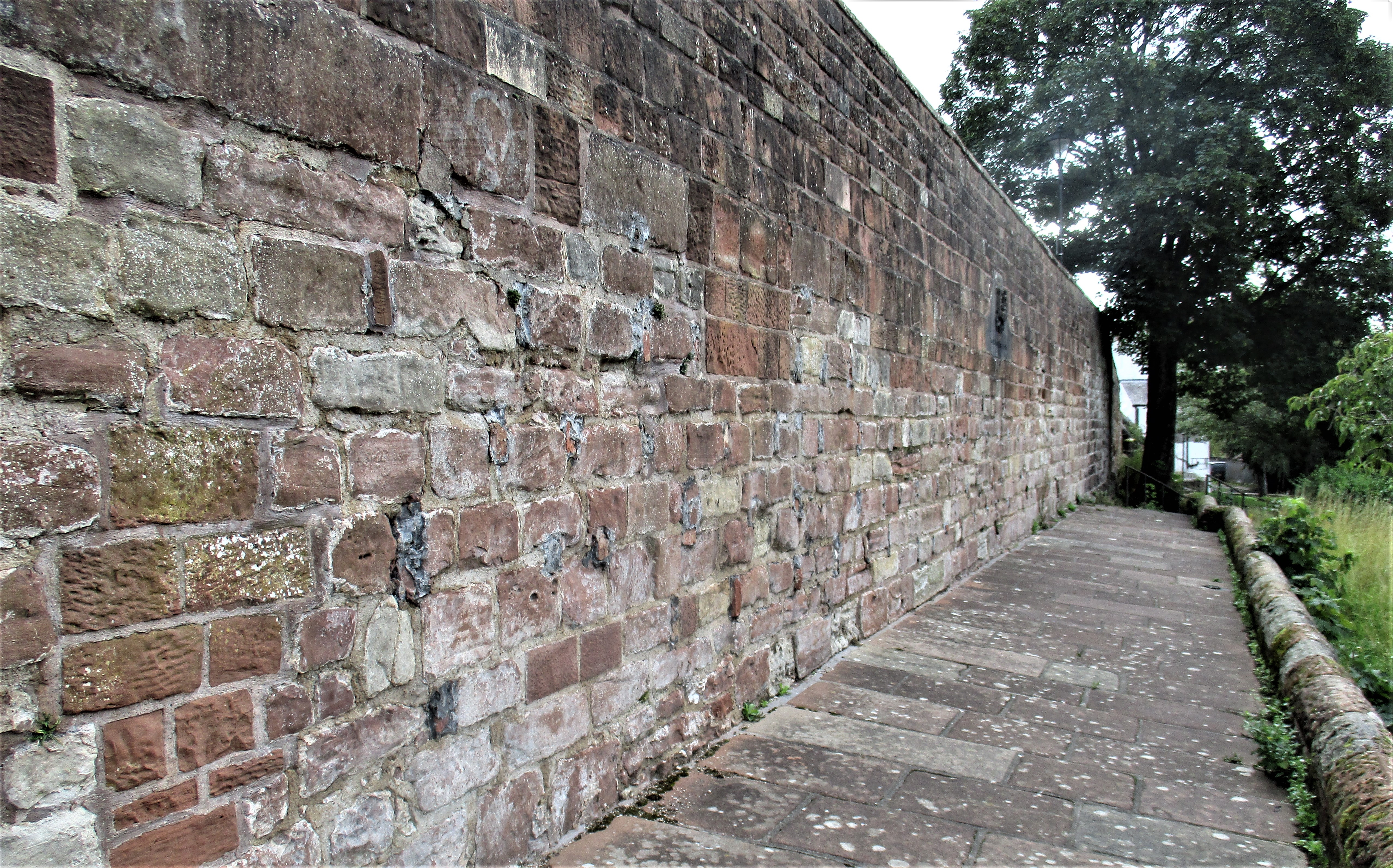
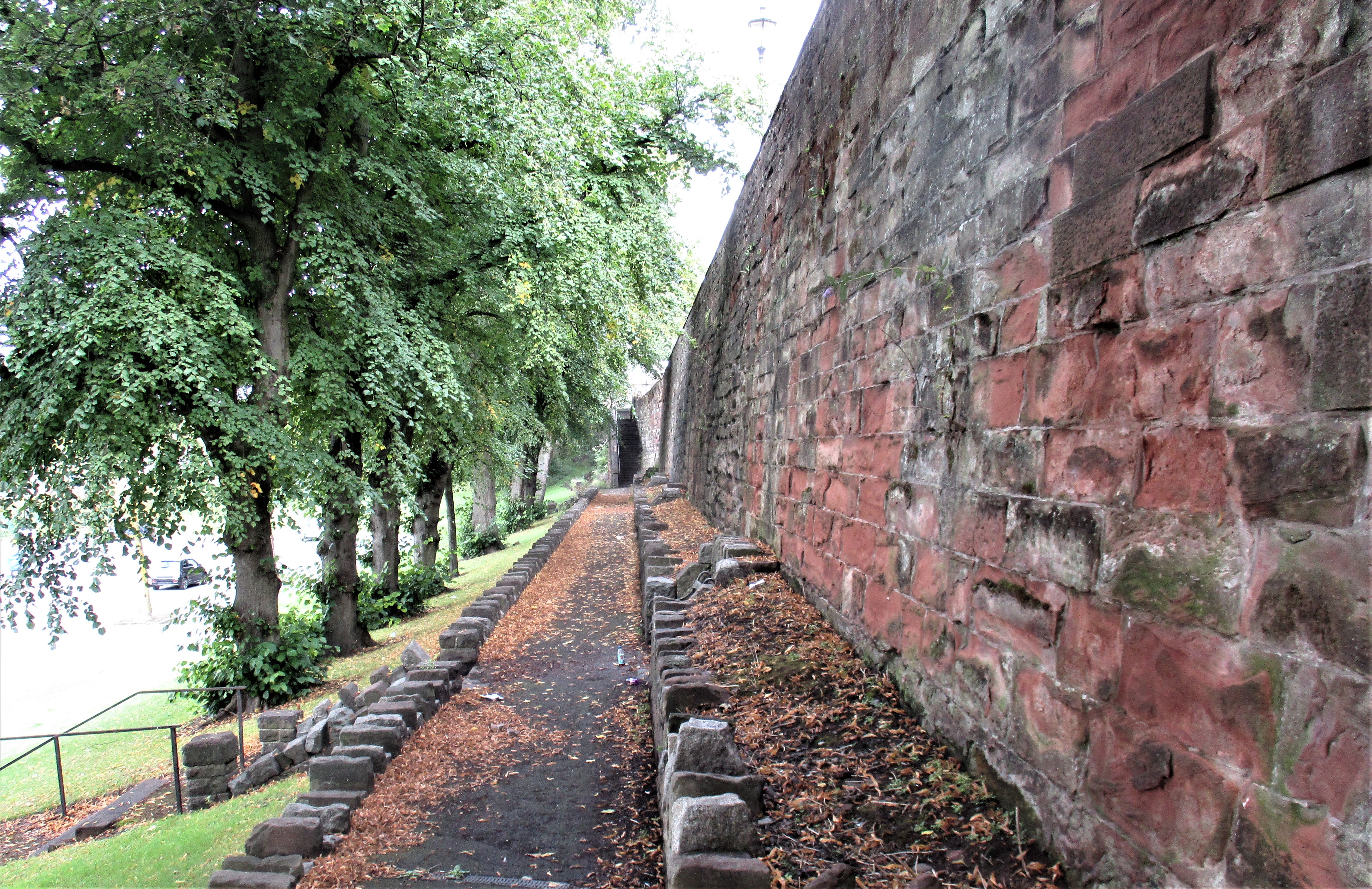
We then followed the outside of what remains of the mediæval city walls:
There were a couple of stone plaques set into the wall, which suggests that these walls were rebuilt at some time in the nineteenth century:
We eventually found a flight of steps that leads to the city’s cathedral. There has been a cathedral on this site since the twelfth century, although I am unable to say how much of the structure that you can see today dates back to this period. The architectural style is Gothic, but when we went inside, I couldn’t help but notice several Romanesque arches at ground level in the area directly beneath the bell tower.

Here are two photos taken inside the cathedral:
The first, taken by Paula, shows the cathedral’s organ, while the second shows the east window. This is what the east window looks like from the outside:
…and these are two other views of the building:
While we were photographing the outside of the building, several people asked us whether we’d seen the policeman. It took us a while to find him, but you can see him in the following photo, a finial on the end of the architrave above the window:
Apparently, this finial commemorates the first policeman ever to lose his life in the line of duty.

All the external shots of the cathedral were taken by Paula.

Having seen everything there is to see in the vicinity of the cathedral, it was time to find somewhere to eat. Paula said that she’d seen some dining places next to ‘the castle’. We’d walked past Carlisle Castle on our way from the bus station to the hospital, and it wasn’t too far away. I didn’t recall seeing anywhere thereabouts to eat, but we headed in that direction anyway. I didn’t realize that when Paula had said ‘the castle’, she was actually referring to the city’s law courts, which are located next to the railway station. You can see the station in the background in the next photo, and you can also see why Paula thought that the law courts were actually a ‘castle’, with their crenellated walls and general quasi-mediæval appearance:
Meanwhile, we walked through Bitt’s Park, the largest urban park in the city, where I spotted these two mosaic ‘armchairs’:
Finally, on our way back to the city centre, we passed a spectacular mural:
It appears to show a Roman gladiator battling an unspeakable demon, although I do wonder whether it is allegorical, and that what you can see is an ordinary Roman soldier fighting off one of the barbarians that lived to the north and repeatedly raided the area south of the nominal border at the time (Emperor Hadrian had a wall constructed from coast to coast to keep out the aforementioned barbarians).

While I was photographing the mural, a woman walking past said this:

“Brilliant, isn’t it? It was painted by a student at the local art college.”

I couldn’t find a signature on the mural, but I agree with the woman’s assessment. I’ve recorded quite a lot of street art in Hong Kong, but this mural is even more impressive than anything I’ve seen there (cf. Tunnel Vision; Down by the Riverside; Latest News from Ghost Alley #2; Fish out of Water).

And that was our brief tour of Carlisle. We found somewhere for a late lunch, then caught the next bus back to Penrith.