Friday, 19 November 2021

scrawl on the wall

Sha Tau Kok Road is the only road that runs east out of Fanling. It is a major highway, a dual carriageway starting next to Fanling station and leading, eventually, to Sha Tau Kok in the far northeast of the New Territories. In the urban area, it separates Fanling’s industrial zone to the south from the habitable part of town.

Because of the development that I’ve been recording recently, we’ve found it necessary to follow the cycle track network through town instead of simply following the Drainage Services access road that runs alongside our local river whenever we want to cycle out west, which is most of the time. And I couldn’t help but notice the graffiti on the walls of the industrial buildings as I passed.

This is a general view from the residential side of the road:
The next two photos are also general views, each of which shows several ‘tags’, which, as far as I understand the culture, is the name given to these works:
Each tag will have been drawn by a different person, and if they’ve been active on walls elsewhere, the same design will have been repeated. In other words, they function as a kind of signature (the nearest tag in the second photo appears to read ‘CRIS’).

Most of the graffiti here are too plain and unimaginative—or merely crude—to be worth further attention, but the next two photos are closer views of the two most distant tags in the first photo:
…while this is a close-up of the most distant tag in the second photo:
Not all the graffiti here are tags. This is my favourite among all the works here:
I assume that this is a dog, but I can’t read what it appears to be barking.

Next to the dog is this graffito, which is crude but amusing:
A short distance further east, the cycle track bends around the back of a Shell filling station, where I spotted this image:
I assume that the number refers to the Great Beast in that well-known work of fiction, the Revelation of St John the Divine, although this creature does not seem capable of bringing about the end of the world!

Much to my surprise, there is also one wall painting here, almost directly opposite the previous image:
I have a strange feeling that I recognize the person portrayed here, although from where I have no idea. And I can’t read the writing, although the last word is obviously ‘die’.The Chinese character right of the person is ‘Buddha’, while the character on the shoulder is ‘Guan’, which may be the person’s name.

In Hong Kong, graffiti are widely considered a form of vandalism, so I’ve only ever recorded one location in the territory with polychrome tags, since painted over, and what I’ve recorded here is of limited interest. However, I’m a huge fan of graffiti, and if you want to see graffiti that I have no hesitation in labelling as ‘art’, check out The Writing on the Fence, which I photographed in Manchester in 2018, or click the ‘graffiti’ label in the right-hand sidebar.

Monday, 8 November 2021

more abandoned houses

I’ve been taking a closer look at a couple of recently abandoned houses in the area now being developed in our neighbourhood. Their locations are shown in the following map, which I photographed hanging on a fence. Among other things, it indicates that a large area of paths will be closed on 15th November, which is next Monday. After that date, I won’t be able to gain access to any more abandoned houses in the area, although all that remains of most other houses is a pile of rubble anyway.
This is the first house, which I’ve probably walked past hundreds of times in the past 13 years:
The approximate location is indicated by the yellow circle on the map.

Notice the writing on the wall. It’s a poetic lament that was almost certainly written by the last occupants. They are lamenting the loss of what they clearly thought of as their home. I will never know for certain, but there’s a good chance that they lived here longer than I’ve lived in the neighbourhood. This is a closer look at the lament, which was written at the time of the last Mid-Autumn Festival, usually a time for celebration:
And this is what I saw when I stepped through the door and looked right:
I’ll wager that the fridge-freezer is still serviceable, and that the occupants weren’t given time to take anything with them that they couldn’t carry when they were told to leave.

And this was their kitchen:
…while this was the main living room:
There were two bedrooms downstairs:
As in other houses that I’ve visited recently, the stairs are extremely steep:
At least there’s a secure if apparently makeshift handrail, or I probably wouldn’t have attempted to venture upstairs, where there was just one bedroom:
This is a vertigo-inducing view of the stairs from above:
I estimate the angle at around 65 degrees!

The location of the other house that I’ve looked at recently is indicated by the blue circle on the map. I particularly wanted to check this house because when it was still occupied, it was policed by an extremely aggressive dog that always snarled at me whenever I walked past. Fortunately, for the dog, there was a wire fence between us. Here are two views from the outside:
I included the first picture because it shows that among the items abandoned here are two wheelchairs!

In fact, there wasn’t much to see in this single-storey house, but I was staggered to note that the main room has a marble floor!
This was, apparently, the only bedroom, complete with mosquito net over the bed:
I’m not sure of the purpose of this room, which may have been just a storage space for clothes:
Every other house in the area has already been demolished, so I don’t expect to write anything more on the subject for the time being, although that is likely to change as the ‘development’ continues.

Thursday, 4 November 2021

the original lotus pond

The area of fish ponds between the frontier road and the actual frontier is rapidly being developed, and as a result, huge numbers of eight- and ten-wheeler tipper trucks have been using the frontier road to deliver their loads. One of the results of this exercise has been extensive damage to the road, which was never built to handle such heavy vehicles (it was part of the so-called ‘closed area’ until 2013). The result, from my point of view, has been that we don’t often cycle this way nowadays.

Another casualty of the development—or so I thought—was a lotus pond next to the old woman’s store, near the western end of the frontier road. I’d taken a few photos of lotus flowers here on several occasions, and I’d noticed that it was a popular site with serious photographers—there always seemed to be several perched on the banks of the pond armed with telephoto lenses whenever I cycled past. However, I thought that it had been filled in.

Yesterday, however, Paula and I decided that, having cycled west as far as the Tam Mei valley, we would return to Fanling via the frontier road. The western half of the road, as far as a police operational base, had been rebuilt, presumably to accommodate police vehicles, and was relatively undamaged. And there was a turn-off to the village of Ma Cho Lung a short distance further on, before reaching the most badly damaged section of the road, which I’ve likened to a rural cart track. We would follow that.

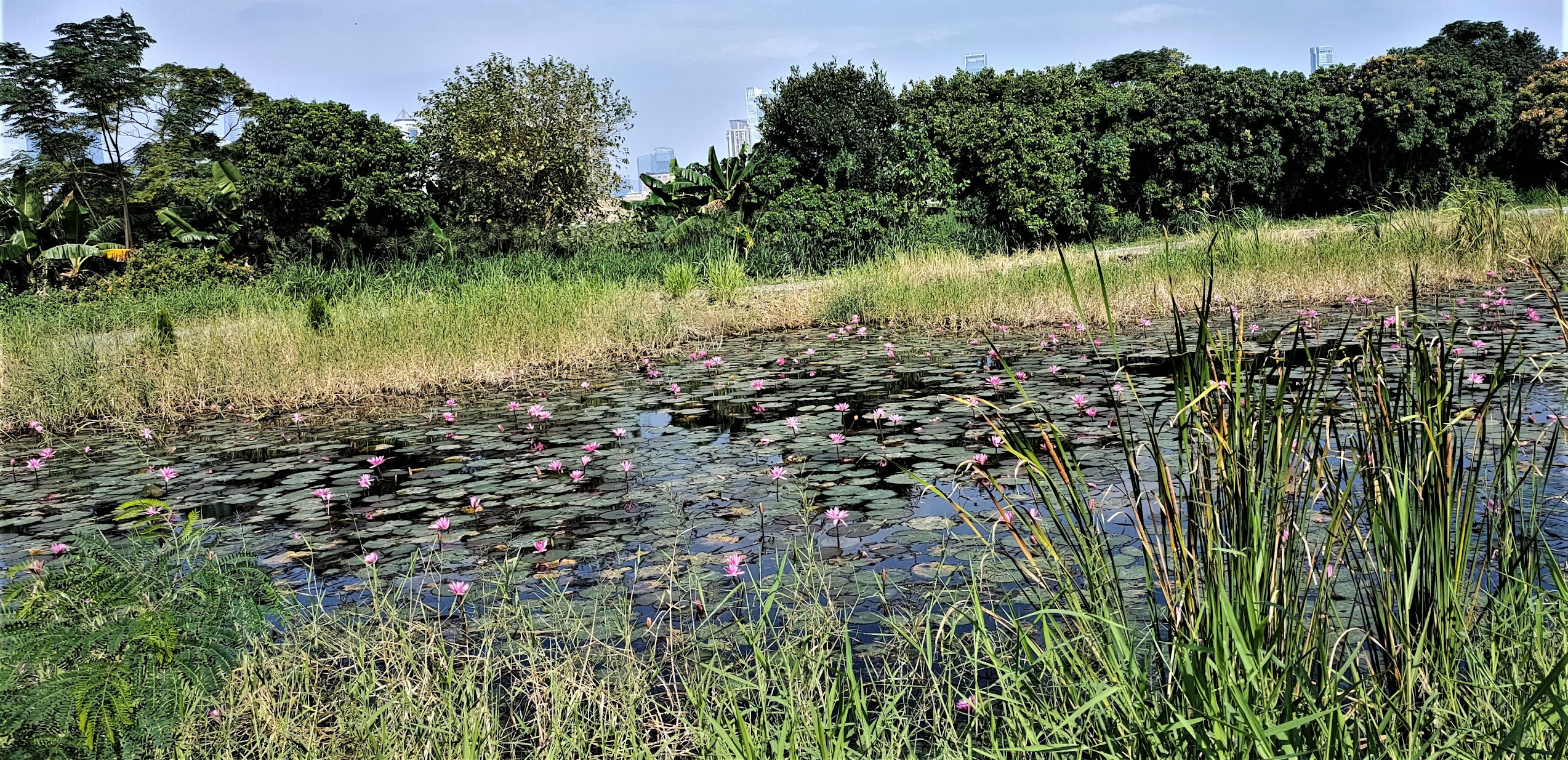
As we passed the site of the lotus pond, I glanced to my left to see whether anything remained of the pond and was astounded to see that it was full of flowers. Naturally, we stopped to take a few photos:
This is a closer look at the last of these photos:
One thing did puzzle me though. I’d posted photos of lotus flowers in a stream that runs alongside San Tin Tsuen Road, which is a few kilometres further west, in May, and I wondered why they were flowering here in November. Of course, when I checked these earlier photos, it was obvious that they were a different species. But both displays are equally impressive.

As a footnote, I’ve included a photo of a pond next to the Ng Tung River, which we’d cycled past at the beginning of our ride. It’s covered in water hyacinths:
This is a closer look at the area of interest:
One thing to note: whenever we’ve seen this display before, it’s been ephemeral, lasting no more than a day or two. We’ll probably cycle past it again tomorrow, and I expect all the flowers to be gone.

Sunday, 31 October 2021

another abandoned house

In my last post, I mentioned that I intended to return to the ‘rotten row’ on Sunday, when no workmen would be on-site, to see whether I’d missed anything. I’ve now done so, but most of the houses have been covered in industrial sheeting since my last visit, and access is no longer possible. However, I was still able to enter the house with the gas canister outside the door, where I took three more photos, which I’ve appended to this account of an abandoned house nearby that I also visited today.
*  *  *
Having photographed everything that I wanted to in this house, I returned to the main path linking Ma Sik Road with the Ng Tung River, which is now my (much longer) way home. A short distance along this path, I reached the start of an overgrown path leading off to the right:
I will have checked out this path many years ago and found that it led just to someone’s house, so decided that it was of no further interest. However, in view of the recent developments in the area, I wondered whether this house might also now be abandoned. It was:
I didn’t take a photo from the doorway, because the interior looked decidedly dingy, but I was gobsmacked by what I discovered in a room leading off to the right about halfway along:
This is the only house I’ve visited with a private shrine! You will notice that the light has been left on in the room to the right of the shrine. I wonder who is paying the electricity bill.

And this is a view inside the room:
I didn’t think it prudent to try to climb up to the upper floor, because there wasn’t a separate handrail, and access was provided by what wasn’t much more than a ladder.

There is also a small kitchen leading off the main room:
Finally, this is a view of the main room from the end opposite the entrance to the house:
You will notice a dog in the doorway. I wonder whether it belonged to the last occupant of the house and has been abandoned like the house, or whether it’s merely a feral dog that has found a convenient place to sleep for the night. It was too nervous to come in once it became aware of my presence.

The path actually continues past the house, and I wondered to where it might lead. To my surprise, I came across a large area that had been planted with banana ‘trees’ neatly laid out in rows:
These photos were taken from the far side of the plot, first looking to the right and then to the left. Judging by the relative absence of weeds, this plot was still being tended until quite recently, although it won’t take long for either the jungle or the developers to reclaim it.

My last photo here is a view of the entrance to the house from the direction of the banana plantation:
*  *  *
Although I eschewed the climb up the ladder in the newly investigated house, I did decide to brave the steep climb to the upper floor in the only house in the ‘rotten row’ that is still accessible. At least it had a handrail. And this is what I saw upstairs:
From the top of the stairs, I had quite a striking view of the main room:
The people living here clearly left in a hurry!

I hadn’t noticed previously that this house also had a kitchen:
…and a toilet adjoining to the right, which didn’t strike me as a particularly hygienic location for such a facility.

I probably missed an opportunity to look inside other houses in the area that were demolished while I was in the UK this summer (Farewell Ma Shi Po), but there are many more further west that are still occupied—for now.