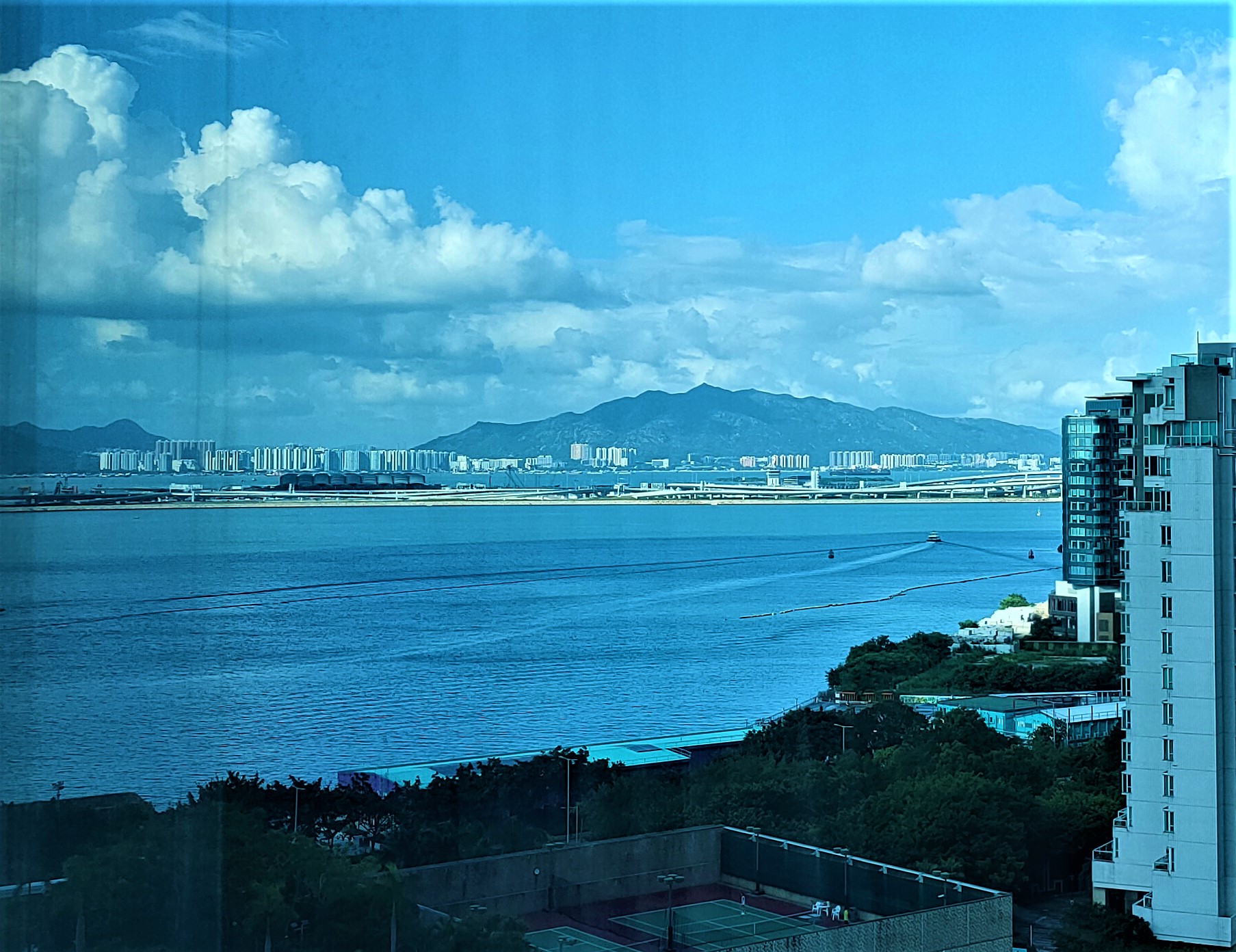
When I tested positive for covid-19 just over two weeks ago, I was sent to a so-called ‘isolation hotel’ on the remote island of Lantau. Paula had to come too, if only because we’d been in close contact. When we arrived at the Novotel, I was dismayed to learn that we had been assigned separate rooms—on the 15th floor—but was relieved to discover that they were connected internally:
The photo above was taken from my room; and this was the view from my window:
Overall, the view wasn’t nearly as interesting as that from the window of our quarantine hotel, details of which I posted in q – 37.
Here are four views across Tung Chung Bay, which was as far to the left as it was possible to see from my room, looking towards the airport:
They were taken on different days. Notice the light blue buildings next to the shore; I believe that they are a ‘regular’ isolation centre, and I’m relieved that we didn’t end up there. Incidentally, I saw just three planes taking off during the 11 days that we were incarcerated, which reflects how little traffic is passing through Hong Kong’s airport nowadays.
And here are four views looking as far right as possible:
I don’t know the name of the mountain, but it’s a reasonable assumption that there’s a good footpath along the skyline.
This is a general view of the estate directly in front of my window:
…while this is a similar view with long shadows cast by the westering sun:
…and this photo shows the sun reflecting on the windows of the far line of four blocks:
And this is a night-time view of the line of residential blocks:
As I reported in According to Plan?, the orange lights on the top of each block came on each evening at precisely 8pm and went off again at 10pm.
This is a view of the street directly below our rooms:
There are certainly a lot of trees!
And this is a night-time view of approximately the same area:
The diagonal structure that you can see in the last two photos is a pedestrian bridge. It carried quite a lot of traffic, but I never saw anyone emerging into the open on the far right. However, when we finally left and were heading for Tung Chung station, we did find out where all the people went after disappearing from view at the right-hand end of the footbridge. A shopping mall:
There was one other feature that I could see from my room:
This is some kind of ornamental garden, which I assumed was part of the hotel. This conjecture was confirmed when we finally left, when I noticed a photo of the garden in the lift taking us down to check-out. However, I saw just one person here during our stay, which I assumed was the gardener. The irregular blocks appear to be part of some kind of water feature, although no water was flowing during our stay.
Finally, what was the food like in the Novotel. There was certainly a lot of it, although I couldn’t finish many of the main meals. Here are two that I did polish off:
The one thing I remember here is the struggle to open the door—and keep it open while collecting each meal from the small table just outside, the delivery of which was announced by a sharp knock on the door. The hydraulic door-closing mechanism was clearly set to maximum!
Thursday, 13 October 2022
Tuesday, 11 October 2022
q – 37
In case you’re wondering about the quasi-algebraic title of this post, it is based on the original meaning of the word ‘quarantine’, which derives from the French word quarante, meaning ‘forty’. This is a reference to the ultimately futile attempts to prevent bubonic plague crossing the Bosphorus into Europe in the Middle Ages during the ill-conceived Crusades and is the number of days that returning Crusaders were compulsorily isolated. The idea of enduring 40 days of quarantine fills me with horror, so it is with relief that I can report that Paula and I had to endure 37 fewer days confined to a room on the 36th floor of the Nina Hotel in Tsuen Wan, from where I took a lot of photos and shot several videos, which I present here in sequence from left (south) to right (north).
You will quickly notice that many of the photos/videos cover similar areas, but I’ve decided to include them all anyway. I would welcome any comments that compare the similarities and differences between different images. This is the general view looking south (sideways to the left from our window):
Compare it with this view, which shows more of the buildings left of the six-lane urban highway:
…and this one, which was probably taken very early in the morning, judging by the paucity of traffic on the highway:
The first thing to draw my attention in these views was the large car park next to the highway, which I assumed was temporary. However, Paula, who is more familiar with the area than me (members of her family live close by), assured me that it has been there for years. This suggests that some kind of financial skullduggery is in play here, because this is a prime site for a large commercial building.
And this is what it all looks like after dark:
This photo was taken at 1.28am, which explains the low level of traffic and why there are so few lights on in the high-rise blocks behind the highway.
This is a short video of the same scene:
The foreground of this video provides just a hint of what I’ve often described as one of the minor delights of Hong Kong, although you won’t find them mentioned in material targeting tourists: its urban parks and gardens. This one, which is known as Discovery Park, is located directly below our window:
I also shot two videos around the time of the evening rush hour. They’re very similar, and I couldn’t decide which one to leave out, so I uploaded them both to my YouTube channel:
You may notice that a football match is being played on a sports ground in the distance.
Moving left, this is a view of the two apartment blocks that you can see on the right of the first photo above:
…and this is a similar view showing more of the area of water behind:
This is the Rambler Channel, which separates Tsuen Wan from the island of Tsing Yi on the far side. Incidentally, 50 years ago, this channel was lined with industrial premises on both sides and was known, rather facetiously, as ‘the Tsuen Wan Riviera’. There is no industry here nowadays, just residential estates, but the old name is preserved in the name of the estate that you can glimpse behind the sports ground to the left of the two towers: Riviera Gardens.
Here are four night-time views, moving progressively rightwards from the two towers:
Next are three views looking west along the Rambler Channel:
…and this is a video that I shot of the same area. Most of the ‘action’ takes place on the water, so it’s probably accurate to describe it as being ‘in slow motion’:
Other things that you can see in this video include double-decker buses entering and leaving a covered bus station in the middle foreground; and the line of urban (red) taxis on the opposite side of the road, waiting to pick up passengers from the ferry pier. The large stationary vessels in the middle of the channel are at anchor.
It isn’t unusual for the various blocks in a housing estate to differ slightly in height, but the estate that you can see on the far right of the first photo in the last sequence has four blocks, each of which differs by around 10 storeys from adjacent blocks. This is a night-time video of this estate:
You can also see part of one of the suspension bridges that I mentioned in According to Plan?, the one that connects Tsing Yi with the mainland New Territories, in the second photo of the sequence.
And this is a night-time photo of the same general area:
The Nina Hotel is linked by a bridge at the 40th floor to the Nina Tower, which at the time of its construction was the tallest building in Hong Kong (it isn’t now, of course):
I believe that the eponymous Nina was the wife of the local property tycoon who built the tower, which puts on quite a light show every evening:
Unfortunately, I was probably too close to get the optimum view. I couldn’t read much of the Chinese zooming upwards at two points in the video, apart from the words ‘seventy-three years’, which is how long the Chinese Communist Party has been in control of China, suggesting that this display is a hangover from celebrations of Chinese National Day on 1st October!
Finally, what was the food like that was delivered outside our door in the Nina Hotel three times a day? This is a photo of our third evening meal:
…and this is the third lunch, which we would have missed if I hadn’t tested positive for covid-19:
One of my favourites: sweet and sour pork! Ho sik (‘good eat’), as we say in Hong Kong.
Labels:
hong kong,
photography,
video
Sunday, 9 October 2022
frankfurter free range
The first thing that I noticed upon arriving at Frankfurt Airport on our way back to Hong Kong was the polished granite floors. No! That’s not quite accurate. What I noticed was the proliferation of ‘impurities’ in the granite. The technical term for such a body is xenolith (Greek: ‘foreign stone’). Whenever molten magma is intruded into existing rock, whether it is sedimentary, igneous or metamorphic, bits of this so-called ‘country rock’ fall into the magma. Smaller pieces will dissolve completely, and their presence can be detected only by detailed geochemical analysis, but larger pieces do not dissolve and can still be seen once the magma has cooled and solidified, like the examples in these two photos:
The two adjacent blocks in the first photo appear to vary in mineralogical composition, but that isn’t unusual, even in rock from the same quarry. Incidentally, if you’re from Penrith, you can see some good examples of xenoliths in the Shap granite that has been used to add a decorative touch to a few buildings in the town centre (check out Tough Stuff for a detailed description of the geology).
With a seven-hour stopover in Frankfurt, I spent quite a lot of time simply wandering around to see whether there was anything else worth photographing. The next photo, of a kind of glassed-in atrium, is probably my favourite, with its reflected intersecting lines making an interesting abstract composition:
There wasn’t much to see of interest outside the terminal, and I took this photo merely to show that the weather was fine while we were cooped up indoors:
However, I did realize that I would see a sunset before we boarded our plane to Hong Kong. And before the sunset, the westering sun did create some interesting lighting effects inside the terminal:
And I did capture the sunset. First, just before the sun disappeared below the horizon:
…then the subsequent lighting effects:
Our departure gate wasn’t accessible during this period, because we had to be able to prove that we had recorded negative covid-19 PCR tests and that we had booked a hotel for our three-day quarantine once we’d arrived in Hong Kong. However, when we were finally allowed to approach the gate, I could see that the sunset show wasn’t over. So I took another photo:
I’ve no idea why there are horizontal strips on the windows here, but I do have a theory. A captive audience?
Labels:
photography,
science
according to plan?
Following this summer’s sojourn in the UK, I expected to be offline for five days as we made our way back to Hong Kong for the winter. It all seemed straightforward: travel down to Manchester a day early in order to take a PCR test for covid-19, without a negative result from which one cannot board a plane bound for Hong Kong; one day to account for the journey and the seven-hour time difference; and three days quarantined in a hotel of our choice (it was 21 days last year!). Of course, we had to foot the bill for this.
Unfortunately, that’s not the way it worked out. Something had to go wrong at some point, and it did. On the morning of Sunday, 25th September, I received a call from the front desk of the hotel where we were quarantined to inform me that we could check out. However, by the time we’d reached the check-out desk, the result of a PCR test I’d taken the previous day had surfaced. Paula and I had joked at the time that it should be a guaranteed negative result, because the person who administered the test had merely swabbed the insides of our cheeks rather than the backs of our throats. However, my result was positive!
So it was back to our room as we waited for what would happen next. I was afraid that we would be sent to one of the temporary isolation centres that have sprung up over the past couple of years, which from a distance look more like temporary prisons (bars on the windows, etc.). However, perhaps because of my age, the Hong Kong Health Department decided to send us to an ‘isolation hotel’ (Paula had to come too, because she’d been in contact with me).
I wondered where this hotel would be located. Although there are many hotels that you could book merely to fulfill quarantine requirements, there are just four that have the status of ‘isolation hotel’. We didn’t have long to wait to find out where we were going, but at least we had lunch before we left, which we’d paid for but didn’t expect to consume if we checked out in the morning.
Time to leave. We were ushered out of the back door of the hotel to a waiting minibus, along with two other ‘guests’ whom I assume had also had the misfortune to test positive for covid-19. It didn’t take me long to realize that we were heading out to Lantau, the largest—and most mountainous—of Hong Kong’s many islands. It had been a remote rural backwater before the construction of Chek Lap Kok, Hong Kong’s new airport, in the 1990s, but now there is a new town (Tung Chung) on the north side of the island, facing the airport, with a rail line connecting it to the main urban areas.
And so we arrived at the Novotel, which would be our ‘home’ for the next 11 days. As we checked in, I learned with some dismay that we would be in separate rooms, but fortunately they were interconnected, presumably for use by families when the Novotel was just an ordinary hotel. I was offered a telephone consultation with a doctor, who prescribed a five-day course of anti-viral drugs specifically targeted at the omicron variant of covid-19. Paula wasn’t given this option, and she tested positive two days after our arrival. I recorded my second negative rapid antigen test seven days after our arrival, but Paula didn’t do so until nine days after first testing positive.
The remainder of this post is a summary of what we’ve been doing during the 16-day period between leaving our house in Penrith on Tuesday, 20th September, and returning to our apartment in a village a short distance east of Fanling on Thursday, 6th October:
Before the pandemic, we always took a bus from the airport to a bus station in Fanling that is within walking distance of our village. However, we had no choice on this occasion, because airport buses have plenty of storage room for luggage, while regular buses do not. So we missed the bridges by taking the train.
Our second train change was at Hung Hom, which used to be the southern terminus of the so-called East Rail Line when it was still operated by the Kowloon–Canton Railway (KCR). However, the line was extended last year to Admiralty on Hong Kong island, so the benefit of boarding the train at a terminus—that you could be guaranteed a seat for the 40-minute journey to Fanling—no longer applies. Also, this line used to carry 12-car trains, but since the extension it has been restricted to nine-car trains. Fortunately, we were able to obtain seats. Incidentally, on the second leg of our train journey, someone got up to offer me their seat. Although this practice does make me feel old, I’m not complaining.
And it was reassuring after being cooped up in hotel rooms for two weeks to see familiar topographic features from the windows of the train. First, Amah Rock. This large monolith is visible on a hilltop to the east almost immediately the train emerges from the tunnel connecting Kowloon with the New Territories (amah is the Hong Kong word for a female domestic servant, and the story goes that this monolith represents a poor woman carrying an infant in a meh tai, a harness that I once saw regularly being used to carry a young child but don’t often see nowadays. The woman is looking out to sea waiting for her sailor husband, who is overdue, to return home. Tin Hau, goddess of the sea, who already knew what had befallen the husband, is said to have turned the amah into stone to end her suffering.
Then, as the train approached University station, I could pick out the distinctive profile of Ma On Shan (‘Horse Saddle Mountain’), the second highest mountain in the New Territories, on the summit of which I spent several nights in the 1970s to be able to watch the sunrise.
Finally, as the train neared Taipo, once the principal administrative centre in the New Territories under British rule, I could pick out the instantly recognizable outline of Pat Sin Leng (‘Eight Fairies Ridge’) across the watery expanse of Tolo Harbour.
There is an unwanted footnote to this story. During the flight from Frankfurt to Hong Kong, I drank four 330ml cans of Becks, but during the subsequent fortnight, I didn’t consume a single drop of beer. Obviously, I don’t keep a record of my beer consumption, but it could be four decades since I went this long without tasting a single drop (a time when I couldn’t afford to drink beer). Fortunately, however, in anticipation of possible problems, we’d stocked up before leaving for the UK back in June. Cheers!
Unfortunately, that’s not the way it worked out. Something had to go wrong at some point, and it did. On the morning of Sunday, 25th September, I received a call from the front desk of the hotel where we were quarantined to inform me that we could check out. However, by the time we’d reached the check-out desk, the result of a PCR test I’d taken the previous day had surfaced. Paula and I had joked at the time that it should be a guaranteed negative result, because the person who administered the test had merely swabbed the insides of our cheeks rather than the backs of our throats. However, my result was positive!
So it was back to our room as we waited for what would happen next. I was afraid that we would be sent to one of the temporary isolation centres that have sprung up over the past couple of years, which from a distance look more like temporary prisons (bars on the windows, etc.). However, perhaps because of my age, the Hong Kong Health Department decided to send us to an ‘isolation hotel’ (Paula had to come too, because she’d been in contact with me).
I wondered where this hotel would be located. Although there are many hotels that you could book merely to fulfill quarantine requirements, there are just four that have the status of ‘isolation hotel’. We didn’t have long to wait to find out where we were going, but at least we had lunch before we left, which we’d paid for but didn’t expect to consume if we checked out in the morning.
Time to leave. We were ushered out of the back door of the hotel to a waiting minibus, along with two other ‘guests’ whom I assume had also had the misfortune to test positive for covid-19. It didn’t take me long to realize that we were heading out to Lantau, the largest—and most mountainous—of Hong Kong’s many islands. It had been a remote rural backwater before the construction of Chek Lap Kok, Hong Kong’s new airport, in the 1990s, but now there is a new town (Tung Chung) on the north side of the island, facing the airport, with a rail line connecting it to the main urban areas.
And so we arrived at the Novotel, which would be our ‘home’ for the next 11 days. As we checked in, I learned with some dismay that we would be in separate rooms, but fortunately they were interconnected, presumably for use by families when the Novotel was just an ordinary hotel. I was offered a telephone consultation with a doctor, who prescribed a five-day course of anti-viral drugs specifically targeted at the omicron variant of covid-19. Paula wasn’t given this option, and she tested positive two days after our arrival. I recorded my second negative rapid antigen test seven days after our arrival, but Paula didn’t do so until nine days after first testing positive.
The remainder of this post is a summary of what we’ve been doing during the 16-day period between leaving our house in Penrith on Tuesday, 20th September, and returning to our apartment in a village a short distance east of Fanling on Thursday, 6th October:
Frankfurter Free Range. I haven’t travelled with Lufthansa for more than two decades, but there aren’t many options for travel to Hong Kong at the moment—British Airways cancelled all its flights between Hong Kong and the UK with no warning back in June, although they did rebook us with Cathay Pacific, the only airline that flies direct, with no stopovers, from Hong Kong to Manchester.
Anyway, we had to endure a seven-hour stopover in Frankfurt Airport on our way back to Hong Kong, and although we quickly found some comfortable seats to pass the time, I spent quite a lot of that time wandering around to see whether I could take any interesting photographs. This post features the photos that I took here, of which this is an example:
Incidentally, earlier this year the Hong Kong government imposed temporary bans on airlines that imported covid-19 cases into the territory, and I imagine that it has a clear picture of just how many new cases are still arriving, and from where. I mention this mainly because I believe I picked up covid-19 during the flight to Hong Kong. I’d noticed several signs around Frankfurt Airport stating that it was a federal requirement that all passengers wear masks on flights into and out of Germany, but the flight was full, and meals were served during the flight. Also, the toilets were in a dreadful state towards the end of the flight, and it isn’t too much of a stretch to imagine that an infected person removed their mask while using the facility. I recorded a negative PCR test upon arrival in Hong Kong but tested positive two days later.
q – 37. Last year, we endured our 21-day quarantine period (q – 19) in the Marriott Hotel, which overlooks the western approaches to Hong Kong’s harbour. Although this was interesting for a time, it became boring long before the three weeks were up. This year, Paula booked the Nina Hotel in Tsuen Wan, which is technically in the New Territories but is also one terminus of the second line built by the Mass Transit Railway (MTR) in the late 1970s/early 1980s. It ought to be easier to get home after the quarantine period than it was from Hong Kong island last year.
Our room was on the 36th floor of the hotel, and it was located in the corner of the building, with windows on both sides, so I spent the three days here taking bird’s-eye photos from different windows, including the window in the toilet cubicle, at different times of day (and night). This is a typical example:
A six-lane highway through a residential area is not something I would expect to see in many places.
Isolation (link not yet active). I spent a lot of the time in the Novotel sleeping, mainly because there wasn’t a lot else to do, but I did take some interesting photos. This is a view of the ‘wall’ of apartment blocks that is directly in front of our window on the 15th floor of the hotel:So it was finally time to head home. Tung Chung MTR station is just a short walk from Novotel, and taking the train seemed the obvious choice, despite having to change trains twice on our way to Fanling. At this point, I have a word of advice for anyone visiting Hong Kong for the first time: do not take the Airport Express in order to get into town. It’s convenient, certainly, but if you do, you will miss one of the minor wonders of Hong Kong: the three spectacular suspension bridges that link the airport, and Lantau, with the rest of the territory. The first two link Lantau with the island of Tsing Yi, while the third links Tsing Yi with the New Territories west of Tsuen Wan and is not followed by either the Airport Express or the Tung Chung Line, which we took on this occasion. So what’s the problem? The railway does cross the first two bridges, but only via a quasi-tunnel below the roadway. And you see nothing. Take a bus!
The orange lights at the top of each block came on at precisely 8pm each evening and went off again at 10pm. They took several minutes to build up to full intensity, and you wouldn’t spot the exact switch-on moment unless you already knew it was happening.
To provide some indication of the mountainous nature of Lantau, I took several photos looking to the right from our window, but I’ve selected this photo to include here because the low sunlight from the west highlights the shape of the mountain slopes very effectively:
All the buildings in the foreground are schools!
Before the pandemic, we always took a bus from the airport to a bus station in Fanling that is within walking distance of our village. However, we had no choice on this occasion, because airport buses have plenty of storage room for luggage, while regular buses do not. So we missed the bridges by taking the train.
Our second train change was at Hung Hom, which used to be the southern terminus of the so-called East Rail Line when it was still operated by the Kowloon–Canton Railway (KCR). However, the line was extended last year to Admiralty on Hong Kong island, so the benefit of boarding the train at a terminus—that you could be guaranteed a seat for the 40-minute journey to Fanling—no longer applies. Also, this line used to carry 12-car trains, but since the extension it has been restricted to nine-car trains. Fortunately, we were able to obtain seats. Incidentally, on the second leg of our train journey, someone got up to offer me their seat. Although this practice does make me feel old, I’m not complaining.
And it was reassuring after being cooped up in hotel rooms for two weeks to see familiar topographic features from the windows of the train. First, Amah Rock. This large monolith is visible on a hilltop to the east almost immediately the train emerges from the tunnel connecting Kowloon with the New Territories (amah is the Hong Kong word for a female domestic servant, and the story goes that this monolith represents a poor woman carrying an infant in a meh tai, a harness that I once saw regularly being used to carry a young child but don’t often see nowadays. The woman is looking out to sea waiting for her sailor husband, who is overdue, to return home. Tin Hau, goddess of the sea, who already knew what had befallen the husband, is said to have turned the amah into stone to end her suffering.
Then, as the train approached University station, I could pick out the distinctive profile of Ma On Shan (‘Horse Saddle Mountain’), the second highest mountain in the New Territories, on the summit of which I spent several nights in the 1970s to be able to watch the sunrise.
Finally, as the train neared Taipo, once the principal administrative centre in the New Territories under British rule, I could pick out the instantly recognizable outline of Pat Sin Leng (‘Eight Fairies Ridge’) across the watery expanse of Tolo Harbour.
There is an unwanted footnote to this story. During the flight from Frankfurt to Hong Kong, I drank four 330ml cans of Becks, but during the subsequent fortnight, I didn’t consume a single drop of beer. Obviously, I don’t keep a record of my beer consumption, but it could be four decades since I went this long without tasting a single drop (a time when I couldn’t afford to drink beer). Fortunately, however, in anticipation of possible problems, we’d stocked up before leaving for the UK back in June. Cheers!
Labels:
chinese culture,
hong kong,
photography,
railways
Subscribe to:
Posts (Atom)