Tuesday, 10 January 2023

the bridge of signs

I may seem to be dogmatic in some of my opinions, but in fact I do like to discover that I’m wrong about something. Take this example, from my recent post about graffiti in Fanling:
I’ve not seen anything that matches the complexity of graffiti that I’ve seen in European cities…
Since writing this generalization about graffiti in Hong Kong, I’ve discovered a location where the graffiti can legitimately be described as ‘art’. It happened like this:

A couple of days ago, Paula and I decided to visit Wun Chuen Sin Koon, a Taoist monastery on Ping Che Road, northeast of Fanling. We had been there over the Christmas period, but when we discovered that the car park was full of tour buses, we turned away—this is a place that is best visited when there aren’t many people.

Although bus and minibus routes pass the monastery, we chose to walk there, because there are plenty of paths—if you know about them. We were walking along a footpath that connects Kwan Tei North and Ko Po North, two ‘villages’ that, judging by their names and the absence of houses built according to the 1972 Small House Policy, are overspill from the main villages south of Sha Tau Kok Road.

On this path, there is a point where another path branches off to the left, and that is the path we should have followed, but Paula was leading the way, and I decided to see where she was planning to take us, so I said nothing when she continued straight on. And we eventually arrived at Sha Tau Kok Road. Whenever I cycle along this dual carriageway, I follow a cycle track on the south side of the road, so instead of backtracking, I thought it might be useful to see whether there were any paths leading off to the north.

After a short distance, we crossed a canalized river, and on the far side I spotted a locked gate bearing this sign:
Drainage Maintenance Access
No Entry
The Drainage Services Department (DSD) often has access roads to the rivers and storm drains for which it’s responsible, so I simply stepped around the side of the gate to see if we could get anywhere. Paula followed, reluctantly at first, but was the one who spotted this painting of a mouse on the bridge abutment opposite:
If this had been all there was to see here, I would probably have been happy with this photo, but I noticed that there appeared to be more artwork under the bridge. I wanted to take a closer look. However, getting down to the bed of the river didn’t seem remotely straightforward. Climbing straight down from our position was clearly not a safe option, but there was a ramp leading down from the gate to provide access to the river bed for DSD vehicles.

So we were able to take a closer look, and this the close-up that I took of the mouse:
…and this is a closer view of the artwork under the bridge that we could see from the top of the bank:
The next two photos separate the two discrete designs located nearest the camera in the previous photo:
The first image may be another mouse, while the second has echoes of the geometric designs that are typical of much of the graffiti I’ve seen in Europe, although they don’t appear to be spelling a word.

Further left, there are two shapes that appear to represent whales:
To my surprise (and delight), there was more art on the other side of the bridge support:
This is a closer view of the creature nearest the camera in the previous photo:
This is definitely my favourite image here, although I can’t even guess what kind of creature it is intended to represent.

There are more geometric shapes immediately to the right:
Once again, I don’t think a word is being spelled.

And there is another ‘whale’ further right:
I suspect that the black letters next to some of these designs are the initials of the artists responsible, but I can only guess that the regular appearances of ‘21’ are a reference to the year the designs were created.

Although there is clearly room for more art, that’s all there is here at present. However, about 50 metres downstream there is a tunnel about 35 metres long. There was a pack of dogs at the far end, so I didn’t venture far down the tunnel, but I noted that the walls are clear, apart from this abstract design next to the entrance:
At least I thought that it was a purely abstract design, but when I examined my photos, I realized that this is actually an abstract representation of the Chinese characters for ‘Hong Kong’, reading right to left.

It may seem strange to find such detailed artwork in such an out-of-the-way location (you can’t see anything from the main road), but in my last post (Blessing or Curse?) I reported how much of the graffiti I featured had already been scrubbed off or painted over, sometimes only days after they appeared. The artists responsible for the work here obviously didn’t want that to happen, which is why they chose a location that few people will see, let alone complain about. However, I feel that the art here deserves a much bigger audience, which is why I’ve written this post. And I’ll be back a few months later to see if it’s been added to.

Saturday, 7 January 2023

blessing or curse?

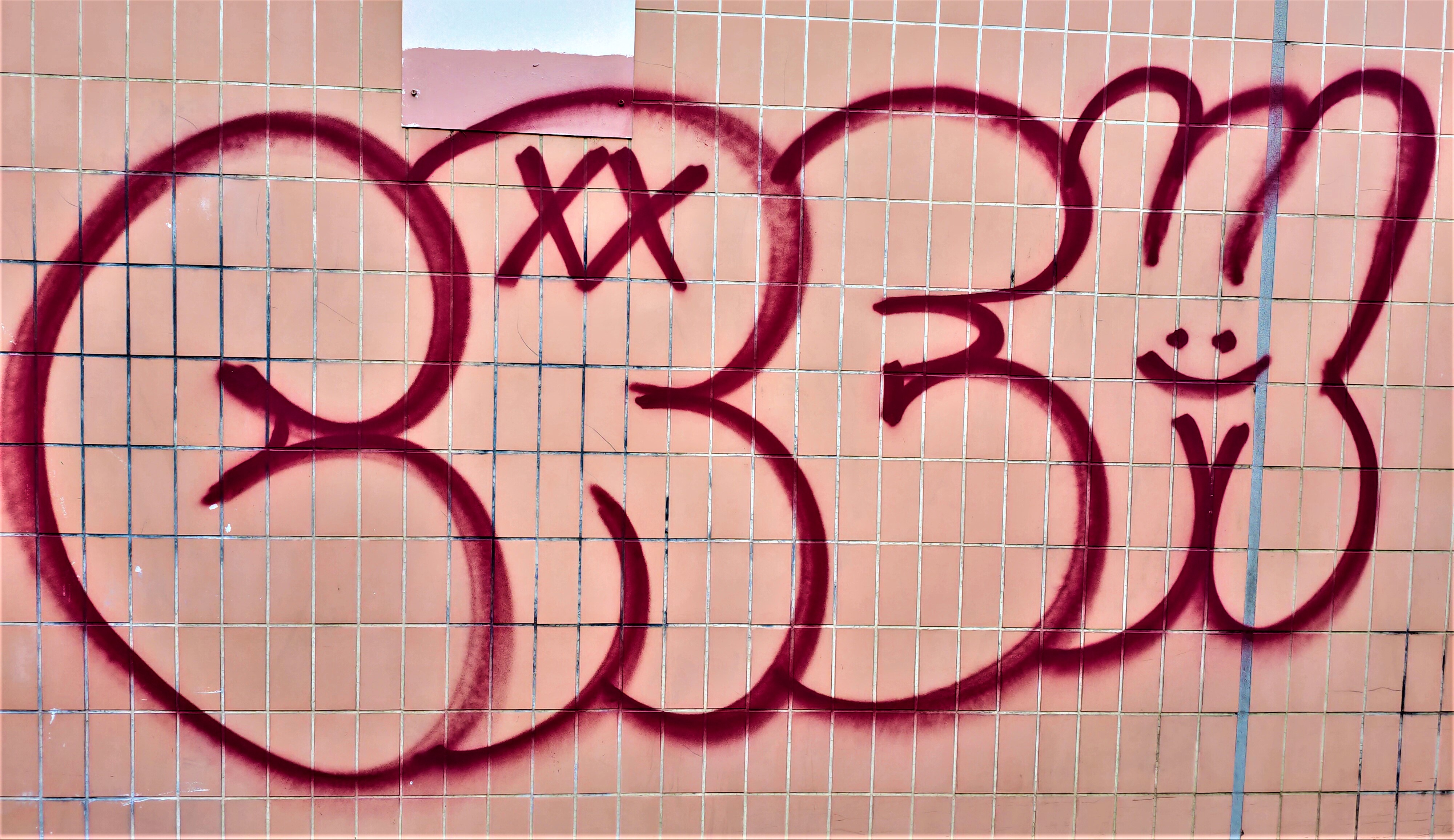
I’ve noted before that graffiti are widely regarded as a form of vandalism in Hong Kong, and while I’ve not seen anything that matches the complexity of graffiti that I’ve seen in European cities, there is definitely a graffiti subculture in the territory. This is my latest report on what I’ve seen in Fanling.

All the graffiti that I recorded in Scrawl on the Wall, apart from that on the back wall of the Shell petrol station on Sha Tau Kok Road, has since been painted over or washed off, but new examples have since appeared, albeit not on the buildings that bore the graffiti I featured in that post. In fact, the majority of the graffiti that I’ve included in this post were located on the walls of one of the two pedestrian underpasses that are the only way to cross Sha Tau Kok Road—a dual carriageway—between its junctions with Fan Leng Lau Road and Ma Sik Road.

I was walking through the more easterly of these underpasses back in November when I saw this:
I was immediately surprised, because this was the first example I’d seen in Fanling of graffiti that included colour, not just black lines. It’s also two Chinese characters—shek tin (‘stone heaven’ from right to left—although I can’t guess what it means).

This is the side ramp leading back up to street level, with the graffito in the previous photo visible on the right:
To my delight, there were several more graffiti on the walls of this ramp, but before I include them here, this is a message on the opposite corner:
It translates as ‘Blessings come to Fanling’! You can also see the straight-on exit ramp in this photo.

And these are the other graffiti I saw as I ascended the side ramp:
The next graffito is not an attempt to write a rude word—fuk is Cantonese for ‘blessing’ (the Chinese character is on the right):
‘CREW’ is a common tag in this area:
And another ‘Fuk1’, this time without the colour fill:
The next two examples were located on the walls of the straight-on exit ramp and include yet another ‘Fuk1’, this time with a different body colour:
There was also a ‘Fuk1’ tag on the wall of the industrial building directly behind the Shell petrol station, which I noticed when cycling past, but when, a couple of days later, I went to photograph it, I discovered that it had already been painted over.

A day or two after this unfortunate discovery, I decided to check out the other underpass to see whether there were any examples of graffiti there. On my way, I spotted another ‘CREW’ on the back wall of the public toilet in Luen Wo Hui:
This is a view of the more westerly underpass, looking south towards Fanling’s industrial area:
There was yet another ‘Fuk1’, in yet another colour, and a second rendition of the ‘7RTC’ that I photographed in the first underpass (I’m guessing the first character of this tag):
This is a photo that I took several weeks later in the second underpass:
The ‘LOVE is EVERYWHERE’ slogan has appeared since in two other locations (see below), and it looks like each was written by a different person.

I’ve been wandering around Fanling’s industrial district recently to see whether I could find any more graffiti here. There is none on the main streets carrying motor traffic, but there is quite a lot on the walls of the many cross lanes. I like this one:
It’s a Chinese character that means ‘make a noise’!

This is a view of the back of a commercial building on the banks of the Ma Wat River:
I featured the three tags on the left, which include another ‘CREW’, in Young Chef and Friends, and they haven’t been cleaned off, but the two on the right are new. One is another ‘make a noise’:
…while I’m unable to say what the other might mean:
I’ve included this ‘CREW’ because of the signs that earlier graffiti here have been washed off:
There used to be quite a few ‘CHEF’ graffiti hereabouts, but this is the only one that I’ve seen recently:
And this ‘Fuk1’ is stylistically different to the others, with the surrounding purple embellishments, which together with the differences in body colour of the other examples above leads me to conjecture that they were done by different people:
I also found two more ‘Fuk1’ outlines in cross lanes hereabouts:
I’ve included the ‘LET’S MOVE’ message on the right of this second outline because I think that the people responsible for the graffiti in this area feel persecuted and want to find a location where their work isn’t scrubbed off weeks or even days after it has been executed:
The next two photos in this collection were taken on the exit ramp from the underpass on which the first photos above were taken:
The green and purple tag, which was probably executed by the same person who created the graffito in one of the photos above, appeared just a couple of days after all the earlier graffiti here had been washed off.

My final photograph is another example of the ‘LOVE IS EVERYWHERE’ message:
The second character on the left means ‘Buddhist’, which may be relevant to the message.

Although graffiti in this area doesn’t last long, I will continue to look, because you never know what you might find here, or anywhere else.

Tuesday, 3 January 2023

spirit in the sky

I had another one of those surprise ‘wow! factor’ moments yesterday. I’ve been unable to do any cycling since my crash in November, so I’ve been doing a lot more walking than I would usually do. And Paula wanted to do a longer walk, so I suggested Wu Tip Shan (‘Butterfly Mountain’), one path up which starts close to the west side of Fanling station.

We’d climbed this mountain before, but we wanted to try a different route, although we did start with the path that we’d used to come down on that earlier ascent. This is a well-constructed concrete path, or staircase as it’s probably better described. I didn’t count the steps, but there are probably well over a thousand, and they are much steeper than the steps up to the Ten Thousand Buddhas Monastery, which we visited last month.

I didn’t stop to take any photos on the ascent, mainly because we wanted to do the ascent in one go, without any rest stops (and we succeeded). When we reached the top, we had the option of turning left or right along the ridge, but turning left would have taken us down the path that we’d followed the first time we climbed the mountain, so we turned right. This is the first photo I took after leaving the summit:
There was a much larger boulder behind and to the left of the position from which I took the previous photo, and there was a short descending path leading down to the side you couldn’t see from the path, so I thought it worthwhile to take a look, in case there were some interesting rock formations. I certainly didn’t expect what I saw when I reached the bottom of the path:
This is a front-on view of the boulder:
The large character means ‘road’, although given the context, ‘way’ is probably a better translation. The six-character phrase translates (roughly) as ‘a place where you can acquire virtue’. The graphic below represents an altar.

I took a few photos to show the ceramic figures, which represent various characters from Chinese folklore, although there are several that I didn’t recognize, in more detail:
There was also a small cluster of figures to the right of the access path:
I particularly like the two figures on the right, which appear to represent Shaolin monks striking kung fu poses (I’d never seen anything like them before).

Because I didn’t think I’d captured everything in my photos, I also shot a short video:

You should watch the video with the sound on, because, believe it or not, there is a sound system, located underneath the pedestal with the cluster of goddesses in the centre of the array, that is playing a continuous loop of religious chanting.

Shortly after we left this location, we faced a long descent:
…and this is the view from the bottom of these steps, looking back up:
A short distance further on, the concrete path came to an abrupt end, but the dirt path that replaced it was more than adequate—to start with. However, a short distance further on, the path began to climb alarmingly. Steps had been cut into the dirt, boxed in with short wooden planks, but many individual steps were almost knee-high, so it was hard to keep going, particularly as every time I looked up, there was no sign of it easing. Eventually, however, we reached a point where a path branched off to the left. The main path continued to climb out of sight, so we turned left. Wouldn’t you?

After a short but awkward descent section, the new path levelled out, and it occurred to me that it was rather scenic, so I stopped to take a couple of photos:
Then I spied a road ahead, although we still had a lot of height to lose to reach the valley below. I took the following photo, of the start of the path, partly because of the sign on the right:
I would consider driving up there to be impossible, even with a four-wheel-drive vehicle, and I would be seriously impressed by anyone who could cycle up there, especially as the road they would need to follow to reach this point is a tough assignment (see below). I also learned from the wooden sign on the left that we had been following the Ngau Kwu Leng Hiking Trail, which I’d never heard of previously, in reverse.

The first obstacle we encountered for anyone driving up the road was a dead tree:
There are several hairpin bends on the road, and these are two of the tightest:
I took the final photo because of the creeper looping down:
I’d never seen a creeper that thick.

I’ve no idea who built this road, or for what purpose, but it does make a good start to a hiking trail.

When we finally reached the valley, we’d also reached the northern edge of Taipo, and I was tempted to walk into the town and catch the train back to Fanling. But, sod it, we’ll walk, even though we would still have a long way to go.

“How are your legs?” asked Paula when we finally got home.

“Like jelly!” I replied.

She knew how I would respond, because she felt the same way.