Sunday, 24 April 2022

jockeying for position: update

Three years ago, I wrote about artwork that I’d spotted on a low concrete wall marking the boundary of a public housing estate on Jockey Club Road, the main north–south artery through Fanling/Sheung Shui (Jockeying for Position). At the time, because part of the wall had not been painted, I conjectured that this might happen eventually, and yesterday, having been cycling ‘out west’, we emerged from the cycling underpass that allows us to cross this road safely, and despite focusing my attention on possible traffic on the cycle track we were about to join, I couldn’t help but notice that the remainder of the wall had indeed been covered. Consequently, I walked down there this morning to take some photos.

This is a view along the wall, which is what I saw yesterday:
The following photos show the images along the wall in sequence, starting from the left:
I had to shoot some photos at an angle because trees on the edge of the pavement, next to the cycle track, meant that I couldn’t get far enough away for a straight-on shot.
When I first saw the circular green objects, I interpreted them as slices of lime (and the theme of the work was food), but then I spotted the frog in the next photo:
They are in fact lotus leaves! The flowers in three of the above photos are lotus flowers! And, of course, the fish are koi carp, which are not noted as food items!

Continuing rightwards:
The artist responsible for these images has named herself in the final image:
This is the first time I’ve seen the artist’s name (Cheng Pui Man) on a mural, and I wonder whether she has any other work in the area that I might see in the future. However, I still believe that the original art on this wall that I featured in Jockeying for Position was the work of local schoolchildren as some kind of art project.

Thursday, 14 April 2022

a crowd on the roof

When we went out cycling a couple of days ago, the original plan had been to ride ‘out west’, but given that the temperature was pushing 30 degrees, we decided that we would just go as far as the western end of San Tin Tsuen Road, a quiet road that skirts around the northern edge of San Tin, then double back.

However, this decision presented a small problem: when we reach the end of San Tin Tsuen Road on our way west, we cross Castle Peak Road to join the Sheung Shui to Yuen Long cycle track, and along this track there is, within a short distance, a convenient rest area with covered seating. Whenever we stop for water, we like to be able to sit down for a few minutes before continuing, and there are no convenient stopping places anywhere along San Tin Tsuen Road.

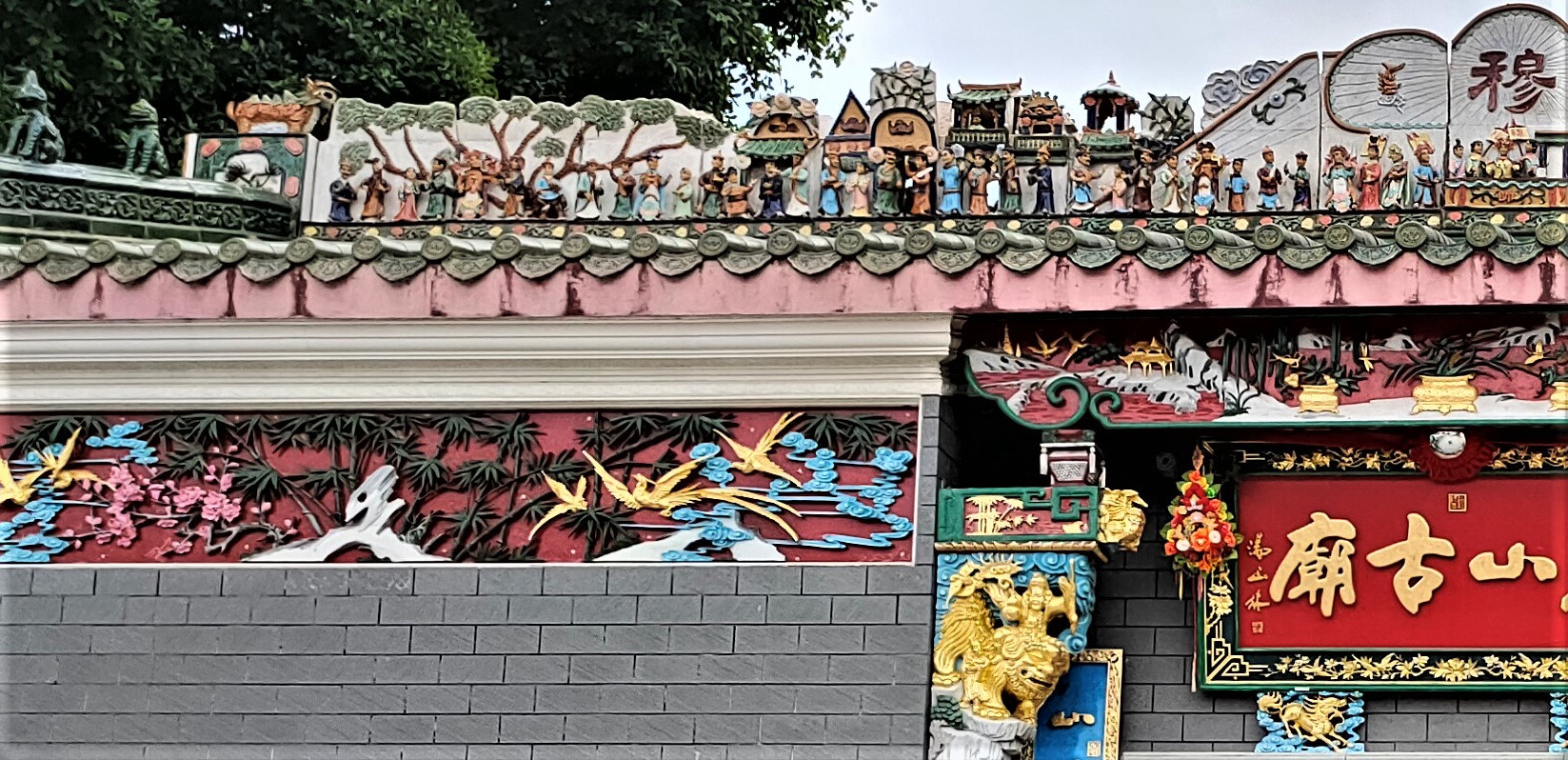
I suggested that we detour into San Tin, which we hadn’t visited for three years, when I wrote about the historical sites there. The intention had been merely to find somewhere to sit down for a few minutes, but having done so almost immediately, I then suggested that, since we were here, we might as well have a ride around San Tin, which has some tricky alleyways to negotiate. We rode past the Man Lung Fung Ancestral Hall and the Tai Fu Tai Mansion, both of which are ‘declared monuments’, without stopping, but when we reached the Tung Shan (‘east mountain’) Temple, I wanted to stop to take a few photos:
It’s quite common to see various figures on the roofs of public buildings such as temples, but I’ve never seen quite so many on one roof. It’s worth taking a closer look:
Although I can’t offer any kind of detailed explanation, this appears to be some kind of street scene, with crowds of people and lines of buildings behind them. The polychrome mouldings under the eaves, which are in excellent condition, appear to show cranes, which are revered in Chinese culture.

Notice too the guarding animals on each side of the temple in the first photo above. They do look fierce. This is the one on the left:
Unless you’re familiar with Chinese culture, you probably won’t be able to identify what kind of creature this is. It’s a lungma (‘dragon horse’), a cross between a dragon and a horse and the basis of the popular salutation lung ma ching san (‘may you have the spirit/vitality of a lungma’).

This is the lungma on the right, which looks equally ferocious:
There are also representations of two lungma directly below the name of the temple, which you can see in the close-up photos of the roof above.

While dragons represent the male principle in Chinese culture, the female principle is represented by the phoenix, and the square plaques in the centre of the walls on each side of the door depict phoenixes:
There are dragons here too though. This is a photo of the tripod directly in front of the door, which is used by worshippers to plant joss sticks:
There is one dragon facing directly to the camera, and two climbing up the sides of the bowl.

Finally, this is a photo of a structure at one side of the courtyard in front of the temple. It is used during funerals to burn paper models of objects such as motor cars that the deceased person can use in the afterlife:
The structure to the right is a village shrine that probably has no connection to the temple.

I’ve been unable to find out when this temple was built, but I did learn that it underwent a major restoration in 1894, four years before the area was taken over by the British. This suggests that the temple is at least 200 years old.

Sunday, 10 April 2022

young chef and friends

After I’d recorded graffiti on industrial buildings alongside Sha Tau Kok Road in Scrawl on the Wall, I began to wonder whether, given the generally negative attitude towards graffiti in Hong Kong, I might find more examples in Fanling’s industrial area, where perhaps there wasn’t the same rush to paint over or wash off graffiti. I didn’t discover a lot, but this is a summary of what I managed to find.

Although all the traffic arteries in the industrial area run parallel to Sha Tau Kok Road, all the graffiti that I’ve found are on the walls of cross-lanes that are not used by motor vehicles, except for parking—where possible. I’ll start with an amusing graffito that I’ve walked past several times:
I’ve no idea who or what ‘Young CHEF’ might be, but it provides a kind of theme to what I’ve discovered elsewhere in the area. Here are three renditions of the tag ‘CHEF’ in three separate locations:
If these were painted by the same person or group, then I would expect them to be identical, but apart from the predominance of the colour blue, they are stylistically quite different. The fourth rendition of ‘CHEF’ doesn’t even follow the similarities of the previous three:
The last photo also includes the Chinese character lau, which can be both a surname and the adjective ‘fluid’, which is reflected in the way the base of the character appears to be dissolving. The mark on the right is not a genuine character, so I cannot comment on its significance.

I took the next photo, of an industrial building at the southern end of the industrial area, from a footbridge over the Ma Wat River:
And here are closer views of the three tags, from left to right:
I had thought, from a distance, that the right-hand tag spelled the word ‘CHEF’, but as you can see, it actually spells ‘CREW’. So these tags are the work of a group of people.

All the remaining photos were taken along a single cross-lane leading directly off Sha Tau Kok Road.

The first photo taken here shows an atypical ‘scrawl’, in that it isn’t just black:
The fat lettering in the next photo reflects the word: ‘SUMO’:
I’ve tried to decipher the next tag, without success, although Paula thinks it spells ‘SAFE’ and may be a reference to drugs:
In The Writing on the Fence, I described how graffiti that I’d come across in Manchester employed the motif of running paint. However, in that case, the graffiti had been meticulously executed merely to create the impression that the paint had been running. Here, the paint really has been running, although that was probably the artist’s intention:
And I can only guess at the significance of the word ‘COLA’, which doesn’t seem to be worth the effort of painting it on a wall.

My final image is the first I’ve seen reflecting the political situation in Hong Kong since the pro-democracy protests of 2019, when political slogans could be seen everywhere, but especially on the walls of underground pedestrian/cycling interchanges:
BELIEF!

Friday, 1 April 2022

…if you please

In Hong Kong, there is a government department whose sole function is to get rid of all the water that falls on the territory, especially during the summer: the Drainage Services Department (DSD). To this end, over the past couple of decades, it has canalized all the major rivers of the New Territories, and smaller watercourses have been lined with wire baskets (gabions) filled with rip-rap (large angular pieces of rock), so major flooding events rarely happen nowadays.

Some time ago, I started to notice signs put up by the DSD prohibiting fishing in any of its rivers, like this next to a bridge over the Ng Tung River close to the village where we live:
I was struck immediately by how polite all these signs were. I hardly need to emphasize how the same injunction would be worded in the UK (and probably, with appropriate changes in language, in other Western countries):

NO FISHING

This prohibition is widely ignored, not only by the local population but also by the local egrets and herons, which perch on the edge of the winter channel of the river looking for a quick meal.

Over the past few months, I’ve started to notice other signs that include the unexpected word ‘please’ in their message, and the remainder of this post provides more examples.

The next photo is of temporary construction barriers alongside our local river:
The request to cyclists to ‘Please dismount and push’ is repeated every couple of metres across the temporary bridge, but I’m not sure why people are also asked to ‘Please Cross Bridge’, given that there is nowhere else to go at this point.

I spotted the signs in the next photo on one of the entrances to Green Code Plaza, a shopping mall on the eastern edge of Fanling. I think that the owners were in the process of repairing the affected doors:
I’ve needed to attend Fanling Clinic on several occasions recently, and on one occasion, while waiting to see the doctor, I spotted two signs where ‘please’ was unexpected:
I would have expected signs like these, in a government-run medical facility, to be more peremptory (in fact, three of the signs here include the word ‘please’)!

The next photo shows a sign on the fence surrounding the Kam Tin Tree House, which I wrote about in A Grand Day Out:
I don’t know whether the warning is against climbing the tree or just the fence, but in terms of conveying a message, ‘please’ is redundant here.

The next photo shows an informal sign alongside San Tin Tsuen Road, a quiet road that we cycle along on our way ‘out west’:
I can’t imagine that the water here is particularly deep—it’s just a large lotus pond—and in any case you would have to climb the barrier, but I have seen wildlife photographers here who might fall in the water. Although it is quite common to see the reason for a prohibition on a sign in the UK, it is more likely to read:

KEEP OUT

I’ve kept the most bemusing sign till last. I didn’t spot it when taking photos for Hidden History #6, only when I was preparing the photos for that post:
While ‘beware of traffic’ is a reasonable exhortation, to see it preceded by ‘please’ seems unnecessary. The additional length of the warning may even be counterproductive, and there is no equivalent pleasantry in the Chinese translation.

Incidentally, there is a warning, only in Chinese, on the red construction barrier that reads ‘beware of pedestrians’. I can’t imagine that many drivers turning left here will even see it, let alone read it.

postscript
I compiled this post two days ago, and yesterday Paula and I were cycling ‘out west’, which meant passing the location of the last photo above on our way through town. To my surprise, not only the construction barriers but also the signs had been removed, which struck me as odd.