This year, I have a different type of puzzle to give you a New Year’s Eve headache:
In the diagram below, each box between ‘torn’ and ‘age’ contains a two-, three- or four-letter word, as determined by the number of ‘bullets’ in each box. Can you identify these concealed words, given that each pair of adjacent boxes makes up a longer word (e.g., ram/page/ant/hem/lock)?
If you found this puzzle sufficiently challenging, you may also like these:
Cracking the Code.
Scramble Six.
Chainwords.
Sunday, 31 December 2017
Wednesday, 27 December 2017
tile styles
When I posted Pavement Mathematics last month, my aim was to analyse the different ways in which a plane could be filled by objects of the same size and shape, in that case by 2×1 rectangles represented by bricks. However, in addition to the ubiquity of brick-covered pavements in Hong Kong, there are many examples of different shapes being used to cover larger areas, and this post discusses some of the many examples I’ve come across in the past two months.
I’ll start with a short section of ‘crazy’ paving on the campus of the Chinese University of Hong Kong (ChineseU). I couldn’t choose between the photos I took, so I’ve included three here:
At first glance, it seems that each shows a network of irregular quadrilaterals, but closer inspection shows that there are a few triangles. Nevertheless, I imagine that it must take considerable ingenuity to make all the shapes fit, although the fit isn’t precise—there is some variation in the spaces between pieces.
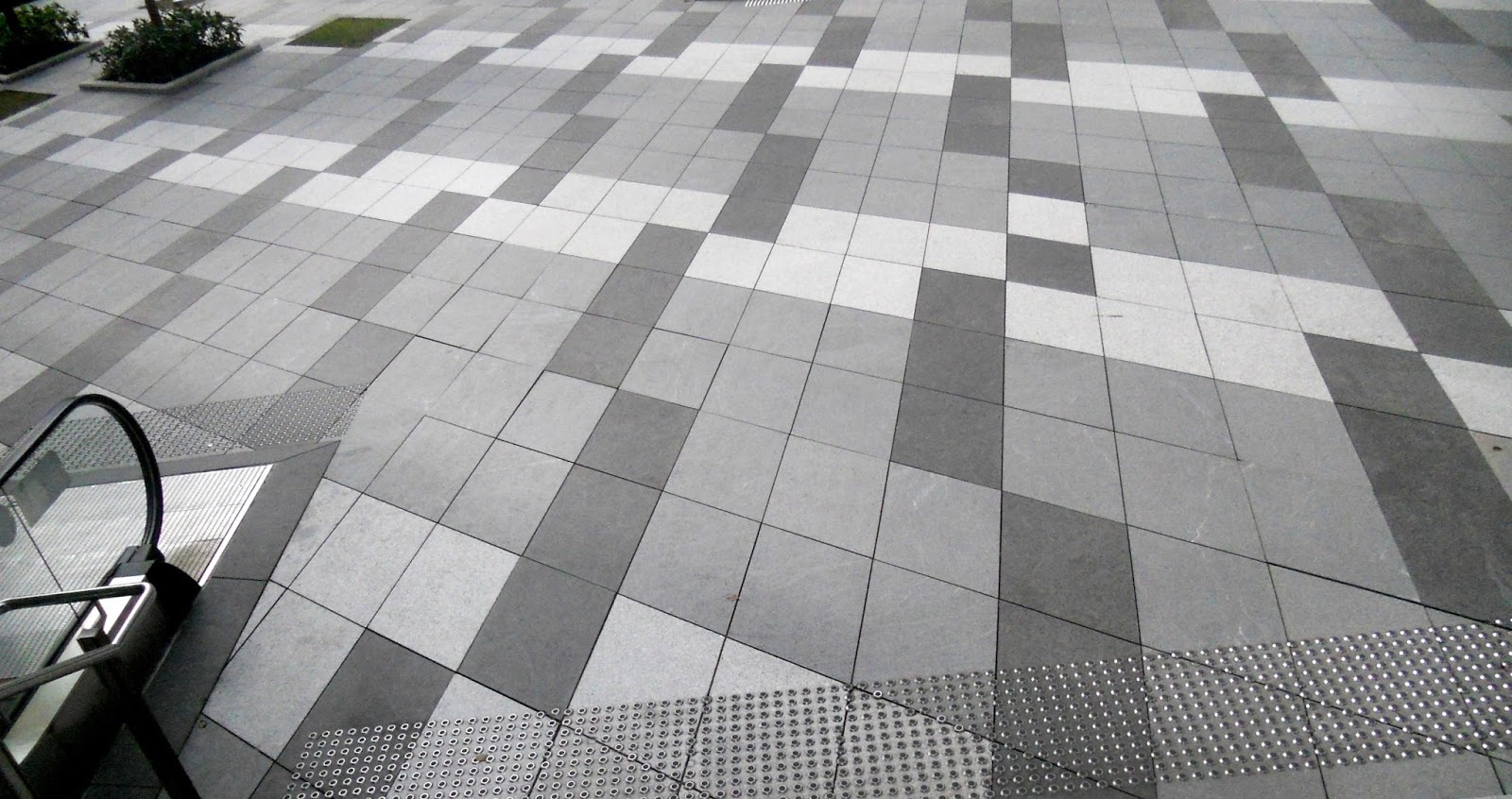
The next photo was also taken on the campus of ChineseU:
You might think that it shows a network of white, light grey and dark grey squares, but you would be mistaken. These shapes are actually rhombuses! Incidentally, can you spot the rhombus that is the wrong colour?
The Hong Kong Science Park is located next to ChineseU, and I spotted this in a bicycle-parking area as I rode past:
It isn’t easy to determine what the pattern is here. Obviously, there is a repeating 4×5 rectangle, which in each case consists of a 3×3 square, a 2×2 square, two 2×1 rectangles and three unit squares, one of which is black. At least I thought that this was the case, but the larger rectangle in the upper centre of the photograph has five unit squares and just one 2×1 rectangle. I shall take a closer look the next time I pass, because it is often the case that when a tile needs replacing, any pre-existing pattern is ignored. If I don’t find any other ‘irregular’ arrangements, then this is what must have happened. By the way, I’m now wondering how many ways it is possible to combine a 3×3 square, a 2×2 square, two 2×1 rectangles and three unit squares to form that 4×5 rectangle.
Closer to home, I took the next two photos in the area surrounding Fu Tei Pai village hall:
Compare these with the following photo, which I took in Cornmarket, Penrith, last summer:
These are ‘stone’ rather than ceramic components, but the design is the same.
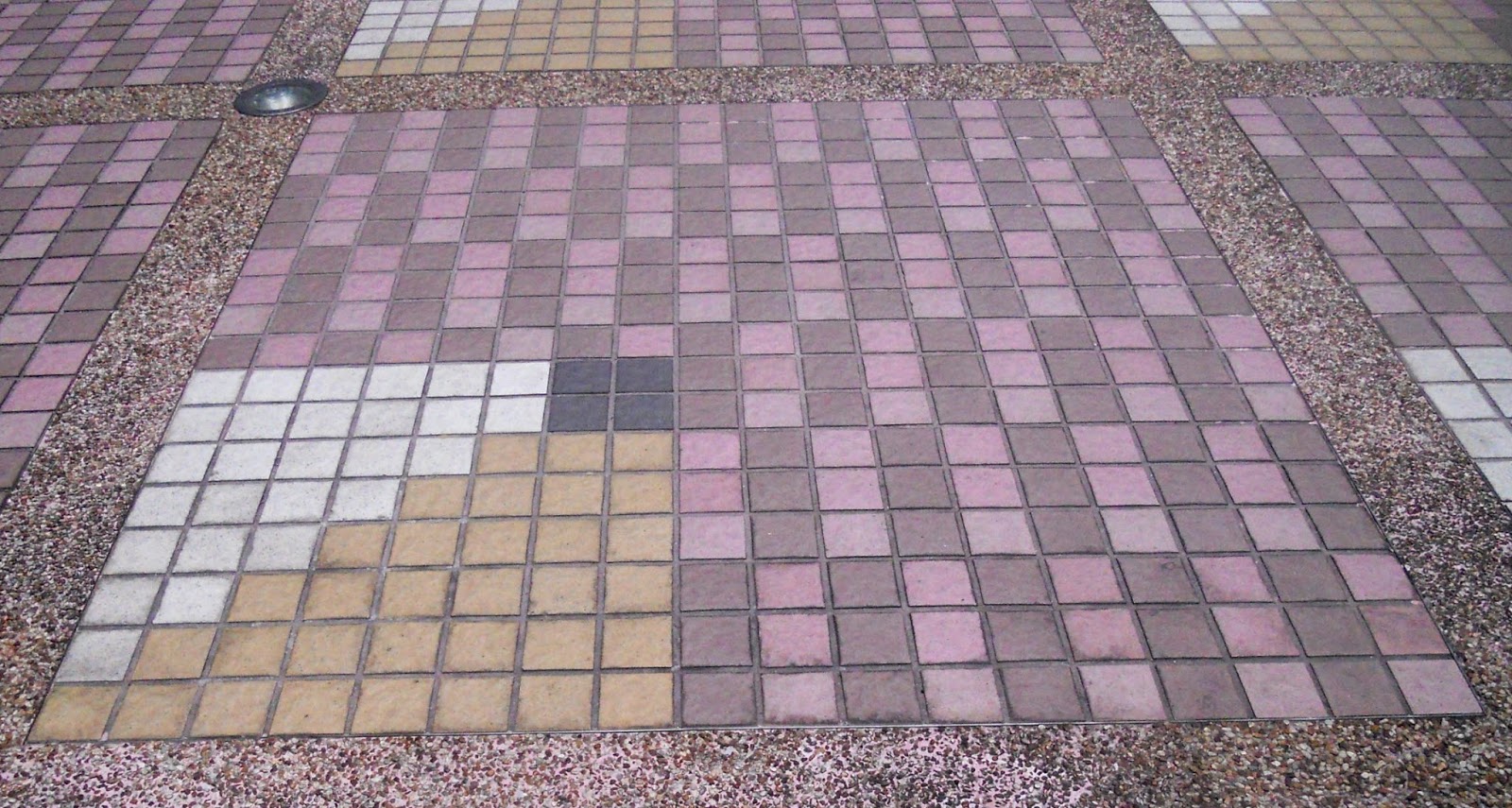
Even closer to home, there are three high-rise residential estates on the eastern edge of Fanling. The largest is Regentville, and the approach to the main entrance of the estate’s shopping mall looks like this:
The basic pattern here is an 18×18 square of pink and purple unit squares, with an 8×8 square of white, yellow and black occupying one corner. This is a closer look at a single 18×18 square:
I can’t help wondering why the white, yellow and black square isn’t precisely a quarter of the larger square, because the way the larger square has been designed, with strings of three alternating pink and purple unit squares, means that there is a remainder of one in each line.
Inside the mall itself, the floor of polished, square red, green and white tiles follows a repeating pattern of larger squares:
This is the view from the mezzanine floor of the central atrium, which shows the pattern more clearly:
I can imagine a fiendishly complex board game being played on this grid.
Regentville was already there when we moved into the area ten years ago, but a new estate, occupying the corner of Sha Tau Kok Road and Ma Sik Road, was completed at the beginning of last year. The associated shopping mall, Green Code Plaza, features the most unusual floor patterns to be seen anywhere. I’ve included just one photo in this collection, because I plan to devote an entire post to these patterns in the future.
The white is polished marble, and the other colours appear to be various igneous rocks. I can’t help wondering whether there is some kind of mathematical formula for these rounded shapes, which are either grey or brown, except where they overlap, when they are black. I keep thinking that I’ve spotted a rule, but then I notice an obvious exception. For example, almost all these shapes are vaguely three-sided, with rounded sides and corners, but there are a couple of four-sided shapes. And, while most of the shapes curve outwards, I’ve noticed the odd one that curves inwards, like a banana. The orange bars are exactly half the width of the basic unit squares, except for a couple that are the same width. In every case, however, the locations and outlines of these shapes appear to be completely arbitrary. I wonder what the thinking behind them was.
Labels:
art,
hong kong,
mathematics,
penrith,
photography
Monday, 18 December 2017
the gates of delirium
Aldous Huxley wrote about ‘the doors of perception’, and I’ve been photographing ‘the gates of delirium’, but we share one thing in common: neither of the phrases is original. Huxley ‘borrowed’ the title of the book that details his experiences with the psychedelic drug mescaline from The Marriage of Heaven and Hell by William Blake, while I’ve appropriated the name of a horrendously difficult rock climb on Raven Crag, Thirlmere. That wasn’t original either. The pioneers of this climb took the name from the title of a song by Yes, possibly the most flatulent of the so-called progressive rock bands of the 1970s. I didn’t know it at the time, because I’d been so disgusted by the self-indulgence of the double album Tales from Topographic Oceans that I stopped listening to them, but from Wikipedia I learn that The Gates of Delirium, from a later album, lasts 22 minutes. I’m not in any hurry to check it out.
Nevertheless, because the phrase has stuck in my memory, I’ve found that whenever I’ve cycled past this gate recently:
…my immediate reaction has been ‘gates of delirium’ every time. This rather grandiose gateway is located in an area south of Sha Tau Kok Road, east of its junction with Ping Che Road, an area that I started exploring after returning to Hong Kong in October. I kept thinking that perhaps I should look out for more grand gateways, and I’ve certainly found a few!
I actually took the first two photos back in May. These gates are located in an area where I’d been trying to extend ‘the long and winding road’, so I could locate them again, but I have no idea what the road in question is called. The first is interesting because it’s the only one in this collection that is not designed to admit motor traffic, and the gateposts are faced with a polished metamorphic rock that does add a touch of class.
The next photo is intriguing because of its use of Western heraldic symbols—the lions rampant and the shield—but the use of gold paint is very common. Note that this gate is designed to slide to one side rather than opening in the middle:
I took the next photo in Fu Tei Pai, a village close to where I live that I hadn’t thought worth exploring until recently. The gate itself is not particularly interesting, but notice the nine separate postboxes mounted on it. Gates like these often provide an entrance to more than one building, and nine means that there are three village houses behind this gate.
Both the next two photos were also taken in Fu Tei Pai, and the thing to note is that they are identical. This tells me that fancy gates like these are mass produced, although they are unlikely to be cheap. These are also gates designed to slide to one side.
In fact, I found a third gate in Fu Tei Pai yesterday with the same wrought ironwork and gold-painted flowers while checking out where a particular road led to (nowhere!). The only difference here is the steel backing panel.
The next two gates are probably located in Fu Tei Pai too. I’ve expressed doubts because it’s common in this area for villages to expand until boundaries are obliterated. So they could be in Kwan Tei.
I particularly like the bronze ‘effect’ in the first example. I suggest ‘effect’ because real bronze would, I imagine, be hideously expensive. Note the postern gate for pedestrians, which is equally elaborate.
I came across the next two gates on the ‘detour de force’—I could hardly miss them, because in both cases they were straight in front of me as I emerged from a narrow alleyway:
The first is another example of lions rampant, but with an unusual style in the ironwork, while the second is the only stainless steel gate in this collection. Although I’ve seen other examples of such ‘sun gates’, this is the only one where the radiating sunbeams are wavy. The real sun was glistening on these bars when I took the photo, but I don’t think I’ve captured just how impressive that looked.
The next two gates are located in Ho Sheung Heung Sun Tsuen, a village that I didn’t know existed until a couple of weeks ago. I was hurtling down Ho Sheung Heung Road past the prison when I noticed a car about to pull out of a side road I wouldn’t normally have spotted, so the next time I came this way I thought that I should check it out. (‘Ho Sheung Heung’ means ‘village above the river’, and I was familiar with the village of that name because of the ancestral hall there; ‘Sun Tsuen’ means ‘new village’.)
The two gates are almost alongside one another, separated by a kind of watchtower, the brickwork of which can be seen in the first photo. The interesting thing about the second photo is what lies behind it. The building within is too big to be a village house, but there is nothing to suggest its purpose, other than that it looks kind of official. Notice that the two gates are almost identical, suggesting that everything behind the gates—the ‘official’ building, the watchtower, etc.—is somehow connected.
Finally, here are two gates in Ping Yeung, easily the largest village in the Ta Kwu Ling area, northeast of Fanling, which I cycle through every Sunday, unless, like yesterday, it’s too bloody cold to get the bike out.
The first protects an ‘ordinary’ village house, but the second is highly unusual, because there is no sign of a building within, the palms suggest that a large area is enclosed, and this is the only gate I’ve come across with actual statues of lions en garde. This is the entrance to the residence of someone who really is rich, unlike all the other gates that I’ve featured, which are intended merely to create the impression that whoever lives within is rich.
Labels:
chinese culture,
hong kong,
music,
photography
Thursday, 14 December 2017
a joke
Would you like to see a joke? No, that is not a mistake! I’m not about to tell you a joke; I’m going to show you a joke.
Yesterday, I cycled out to Plover Cove Reservoir as part of an attempt to improve on my personal best distance total for a single day. There is a dedicated cycle track all the way from Taipo to the foot of the reservoir’s dam, and when I reached this point, I couldn’t help but notice the sign at the foot of the hill leading to the crest of the dam:
As you can see, it barely qualifies as a hill, so I took no notice of the instruction, as you might have expected me to do. After all, I routinely cycle up hills far steeper than this, so I wasn’t about to get off and push my bike (a mountain bike with 5cm tyres) up this pathetic ‘inclined road’.
The sign is repeated at the top of the hill:
…and the view of the ‘hill’ from the top isn’t particularly intimidating either:
In fact, I pedalled downhill—I never freewheel down hills unless I consider it dangerous to keep pedalling, or I can’t go any faster anyway.
However, there is a factor in this injunction to get off and push that I haven’t mentioned. Less than half a mile from the bottom of this incline is the village of Tai Mei Tuk, the principal business of which is the hiring out of bicycles. At weekends and on public holidays, huge numbers of people come here for precisely this reason. For many years, I’ve avoided all the places where I might encounter what, in Cycling in Hong Kong, I described as ‘weekend cyclists’, whose cycling skills range from rudimentary to almost nonexistent. It’s clear that the signs are aimed at these people.
The last time I came here, a couple of years ago, there were no signs, but from previous experience I can visualize the utter chaos that must have prompted the authorities to erect these peremptory warnings, which I felt fully justified in ignoring. After all, I could still manage Liu Pok Hill at the 115km mark on my ride:
…although I did have to drop to the small chainring.
Yesterday, I cycled out to Plover Cove Reservoir as part of an attempt to improve on my personal best distance total for a single day. There is a dedicated cycle track all the way from Taipo to the foot of the reservoir’s dam, and when I reached this point, I couldn’t help but notice the sign at the foot of the hill leading to the crest of the dam:
Note the imperative. The sign doesn’t read ‘Cyclists are advised to…’. No! They must dismount. And here’s the joke:Cyclists must dismount and push cycles on the inclined road.
As you can see, it barely qualifies as a hill, so I took no notice of the instruction, as you might have expected me to do. After all, I routinely cycle up hills far steeper than this, so I wasn’t about to get off and push my bike (a mountain bike with 5cm tyres) up this pathetic ‘inclined road’.
The sign is repeated at the top of the hill:
…and the view of the ‘hill’ from the top isn’t particularly intimidating either:
In fact, I pedalled downhill—I never freewheel down hills unless I consider it dangerous to keep pedalling, or I can’t go any faster anyway.
However, there is a factor in this injunction to get off and push that I haven’t mentioned. Less than half a mile from the bottom of this incline is the village of Tai Mei Tuk, the principal business of which is the hiring out of bicycles. At weekends and on public holidays, huge numbers of people come here for precisely this reason. For many years, I’ve avoided all the places where I might encounter what, in Cycling in Hong Kong, I described as ‘weekend cyclists’, whose cycling skills range from rudimentary to almost nonexistent. It’s clear that the signs are aimed at these people.
The last time I came here, a couple of years ago, there were no signs, but from previous experience I can visualize the utter chaos that must have prompted the authorities to erect these peremptory warnings, which I felt fully justified in ignoring. After all, I could still manage Liu Pok Hill at the 115km mark on my ride:
…although I did have to drop to the small chainring.
Labels:
adventure,
cycling,
hong kong,
photography
Subscribe to:
Posts (Atom)